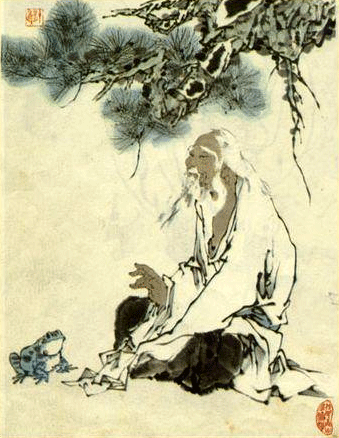
Chuang Tzu's profound observation, "He does not display himself, therefore he shines," invites us to reconsider the nature of presence and visibility in our lives. This statement suggests that true brilliance arises not from self-promotion or ostentation but from a quiet, intrinsic quality that emerges when one is at peace with oneself. In a world often obsessed with visibility and recognition, this teaching serves as a gentle reminder of the power of humility and the understated strength that comes from being authentically oneself.
As we delve deeper into this quote, we find a paradox that challenges conventional wisdom: the more we seek to assert ourselves, the more we may obscure our true essence. Chuang Tzu, through this succinct phrase, encourages us to embrace a form of existence that is less about the self and more about the interconnectedness of all things. In doing so, we can cultivate a light that shines not from the ego but from a place of profound understanding and acceptance of our place in the universe.
The image / the metaphor
The imagery in Chuang Tzu's quote is rich and evocative, suggesting a contrast between the overt display of self and the quiet radiance that comes from inner peace. The verb "shine" implies a natural luminosity, one that does not require external validation or attention. Instead, it suggests a light that emanates from within, a reflection of one's true nature rather than a façade crafted for the eyes of others. This notion of shining without display evokes the image of a star that, while distant and unobtrusive, illuminates the night sky with its inherent brilliance.
In the speaker's tradition
Chuang Tzu's teachings are deeply rooted in the Taoist tradition, which emphasizes the importance of living in harmony with the Tao, or the natural way of the universe. Concepts such as wu wei, or effortless action, resonate with the idea that true brilliance comes from aligning oneself with the flow of life rather than striving against it. This alignment fosters a sense of peace and contentment that allows one's inner light to shine without the need for external validation. In this context, humility is not a weakness but a profound understanding of one's place within the greater tapestry of existence.
Furthermore, the notion of "shining" without display can be likened to the concept of sunyata, or emptiness, found in Buddhist philosophy. Just as sunyata teaches that true essence is found in the absence of attachment and ego, Chuang Tzu's quote suggests that our true brilliance is revealed when we let go of the need to assert ourselves. In both traditions, the emphasis is on the transformative power of humility and the recognition that our interconnectedness with all beings is what ultimately allows us to shine.
Living the teaching
Consider a modern scenario where this teaching might resonate: a workplace environment where individuals often compete for recognition and accolades. In such a setting, one might feel pressured to showcase their achievements and assert their worth. However, by embodying the principle of humility that Chuang Tzu espouses, a person can choose to focus on collaboration and support rather than competition. In doing so, they may find that their contributions are valued not for their visibility but for their genuine impact, allowing their true brilliance to shine through in the relationships they cultivate.
In the realm of personal relationships, this teaching can manifest in moments of conflict or misunderstanding. When faced with a disagreement, one might instinctively want to assert their viewpoint, seeking to be heard and validated. However, by practicing humility and allowing space for the other person's perspective, one can foster deeper understanding and connection. In this way, the act of not displaying oneself—of listening and being present—can lead to a more profound and authentic relationship, where both individuals shine in their unique ways.
A reflection
As we contemplate Chuang Tzu's wisdom, we are invited to reflect on our own lives and the ways in which we seek to display ourselves. Are there areas where we feel compelled to assert our worth or seek recognition? In what ways might we cultivate a deeper sense of humility, allowing our true essence to shine forth without the need for external validation? Consider this contemplative question: How might your life change if you embraced the idea that your true brilliance lies in your authenticity rather than in your visibility?


