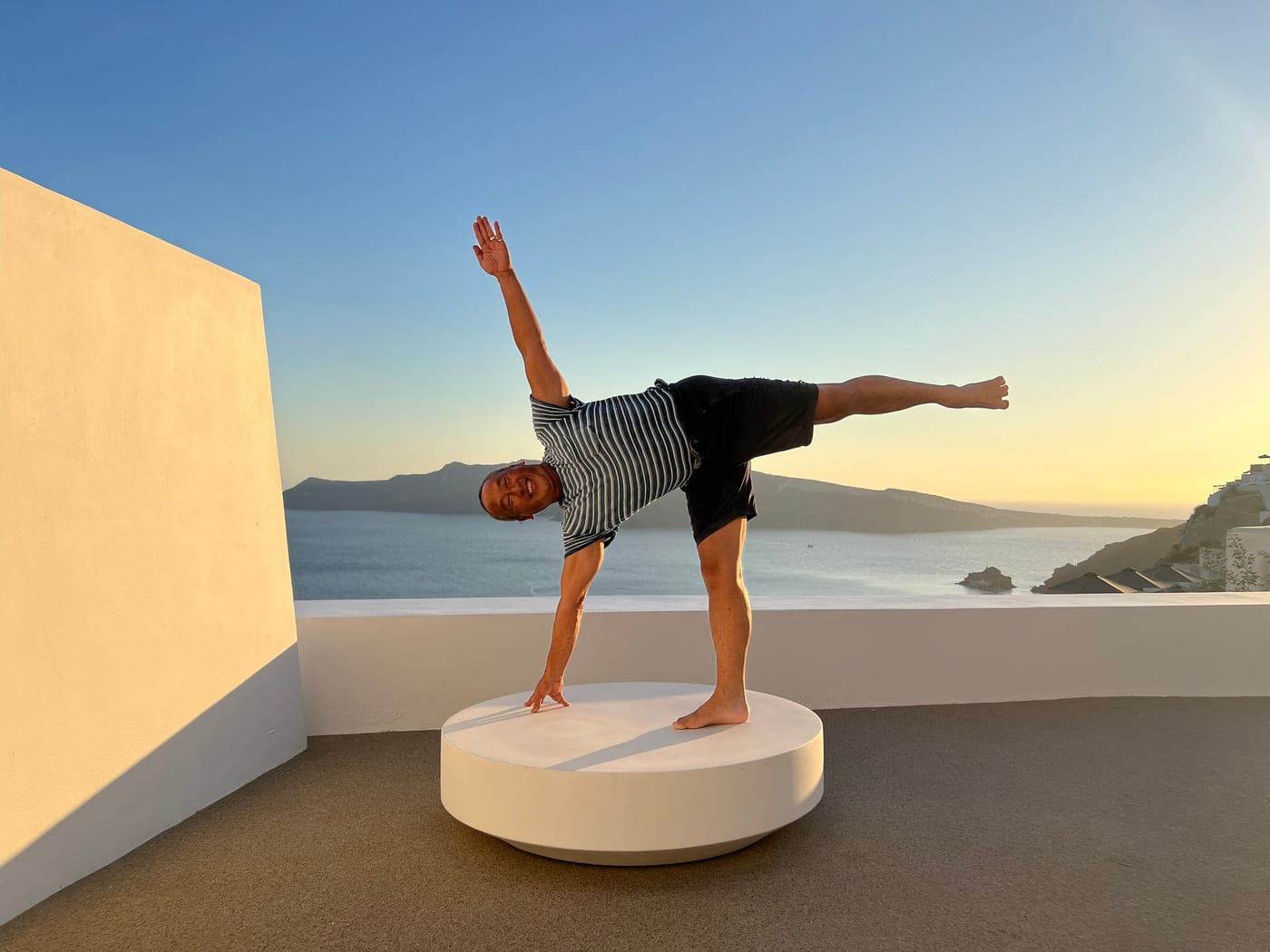

A note before anything else: the source material I have for Rodney Yee lists no specific albums, books, or named videos, so I won't invent titles. The recommendations below point to the parts of his work I can verify, and tell you how to search for the right entry within them.
Start with Yee as a teacher of foundational Iyengar-style practice. He has practiced for some 40 years, and his base is the Iyengar tradition, which is built on precise alignment, patient attention to the body, and the use of structure to produce stillness. Choose one of his beginner-level, whole-body sessions, whether a recorded class or a live one, in the 30 to 45 minute range, and make sure it is explicitly labeled beginner or foundational. Skip anything advanced, anything themed around a goal like weight loss, and anything labeled "flow."
This is the right door because it shows you the core of his approach: the body is the way into the mind, and careful, unglamorous work with basic poses is the practice, not a prelude to it.
1. Urban Zen Integrative Therapy. This is one of his listed areas of expertise and the clearest sign of where his work widened beyond studio yoga. It applies mindful practice to wellness and care. Read about it after you have felt his teaching in your own body, because it will make more sense as an extension of that.
2. His lineage: Donald Moyer, Manouso Manos, and Ramanand Patel. These are the teachers he studied with at The Yoga Room in Berkeley and the Iyengar Institute of San Francisco. Exploring their teaching, or classes in the same tradition, shows you what Yee inherited and what he made his own.
3. The Piedmont Yoga studio story. He co-founded it in 1987. Understanding how a teacher with a background in gymnastics, philosophy, physical therapy, and dance built a community space explains why his teaching feels so integrated.
Expect a teacher who is practical and inquisitive rather than mystical. His path ran from high school gymnastics through philosophy and physical therapy studies at U.C. Davis and U.C. Berkeley, then into professional dance with the Oakland Ballet Company and the Matsuyama Dance Company of Tokyo. That shows in his teaching. You will likely hear anatomical detail and a lot of attention to how a pose is built, with the mental and spiritual dimensions arriving through the body rather than around it.
The pace may feel slower than you expect. You will hold poses and adjust small things, and you may be asked to notice what you would normally skip past.
"This is exercise." The physical rigor is real, but the aim in his bio is peace and deeper insight about the human experience. If you measure a session only by calories or flexibility gained, you will miss the point.
"Iyengar-rooted means rigid." The tradition is exacting about alignment, but the purpose of that precision is to free attention, not to make you anxious about doing it right.
"The spiritual part is separate." Beginners often hunt for the philosophy segment. In his work, mind-body-spirit integration happens inside the physical practice.
"I need to be flexible first." Flexibility is not a prerequisite. Learning to feel what is happening in your body is.
It tends to land hardest when you are disconnected from your body: after long stretches of desk work, during high-stress periods, or when you have been living mostly in your head. It also suits people recovering their footing after a physical or emotional setback, since his emphasis on understanding the body methodically gives you something concrete to hold onto. And if you are a former athlete or dancer who misses the discipline of movement without the competition, his background will feel familiar.
Day 1: Do one beginner session, 30 to 45 minutes. Don't judge it. Notice where you feel effort and where you feel nothing.
Day 2: Rest from formal practice. Spend ten minutes standing quietly, feet grounded, noticing your weight distribution.
Day 3: Repeat the Day 1 session. The second time, focus on one area, such as your feet or your shoulders.
Day 4: Read about Urban Zen Integrative Therapy and write down two sentences on how it connects to what you felt on Days 1 and 3.
Day 5: Do a third session, or a shorter 20-minute version if you're tired. Consistency matters more than length.
Day 6: Look into the Iyengar tradition and the teachers he studied with, Moyer, Manos, and Patel. Note which describes the kind of attention you want to cultivate.
Day 7: Practice once more and compare it with Day 1. Ask what has changed in your attention, not your flexibility. Then decide whether to continue with a regular schedule, ideally three sessions a week for the next month.