In the space between night and morning, or between the exhalation and inhalation of breath, there exists a threshold that most of us rush through without dwelling. Silvia Nakkach's album Liminal makes that threshold its destination. It's a sound journey inspired by clouds—those perfect vessels of impermanence—and guided by a singular artistic principle: original music not attached to any particular form.
The word "liminal" has become fashionable in recent discourse, but its meaning is precise and profound. Derived from the Latin limen (threshold), it describes the in-between state, the boundary space, the transition point where one thing ends and another has not yet begun. In anthropology, liminality is the moment when an initiate stands outside normal social structure, between one identity and another, unbound by the rules of either state. In consciousness studies, the liminal state is neither fully waking nor fully dreaming—a state of heightened possibility and disorientation. It's the space where transformation becomes possible because nothing is fixed, because the usual rules don't apply.
As a musical concept, liminality poses a challenge that few artists have chosen to face directly. Music, by its nature, unfolds in time and requires some architecture to sustain attention and guide meaning. Even experimental and avant-garde music typically relies on internal structures—tonal systems, rhythmic patterns, or at minimum consistent textural zones that create coherence. The classical symphony, the blues progression, the electronic drone, the ambient soundscape—all provide containers, frameworks within which variation and exploration can occur. To commit to "music not attached to any particular form" is to ask a fundamental question: how do we guide listening without these containers? How do we create a sense of journey without a map?
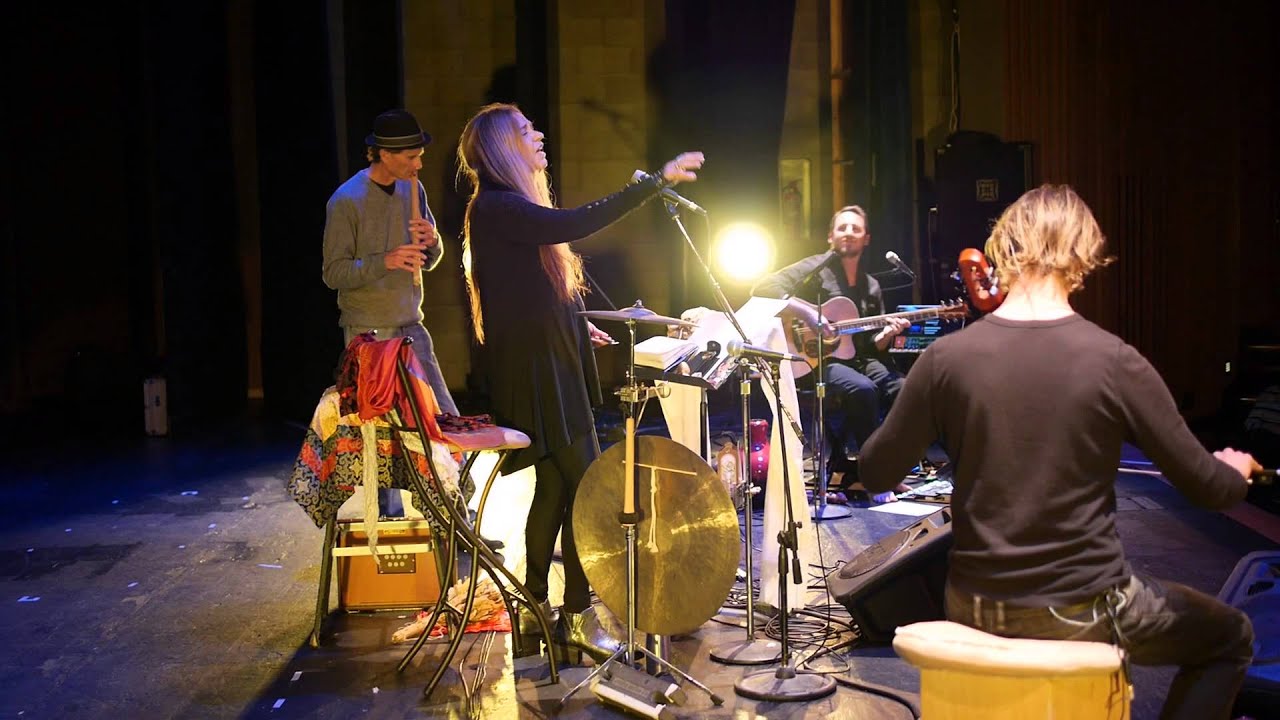
The answer lies partly in the choice of instruments and partly in the collaborative intelligence at work. The album features Silvia Nakkach on voice, David Darling on cello, and Todd Boston on lapsteel, with Boston also serving as producer. This combination is geometrically interesting and intentional: the human voice paired with two string instruments that vibrate at fundamentally different frequencies and across different cultural traditions.
The cello occupies a unique space in Western instrumental music. Historically positioned as the instrument closest to the human voice in its expressive range, it can cry, sing, lament, and celebrate in ways that feel almost linguistic. Cellists from Bach to contemporary performers have exploited this quality, the instrument's ability to speak with almost human nuance. In Liminal, however, the cello's role appears to shift away from projecting character or narrative and toward creating resonant space. The cello's long sustain—its ability to hold a note indefinitely—and its capacity to blur the boundary between discrete pitched notes and continuous texture make it ideal for music that resists formal clarity. Instead of the cello announcing a theme or carrying a melody line, it becomes a voice that holds space, that sustains the threshold between sound and silence.
The lapsteel represents a different genealogy entirely. It's an electric slide guitar, played horizontally across the lap, historically rooted in Hawaiian musical tradition and absorbed into American vernacular styles like blues, country, and slide guitar traditions. The lapsteel is an instrument of glide—it speaks in slides and bends rather than discrete, stopped notes. In conventional music, this characteristic is used for ornamentation, for adding warmth or soulfulness to a phrase, or for blues phrasing with its characteristic bends and blue notes. But in the context of Liminal's aesthetic of unbounded space, the lapsteel's natural tendency becomes fundamental. The instrument's geometry—playing across the body, the slide moving continuously—makes it inherently resistant to clear note boundaries. It naturally lives in the microtonal spaces between the standard chromatic scale, in the glissando, in the spaces between.
When Darling's cello meets Boston's lapsteel, we hear the meeting of two approaches to sustain and transformation, yet originating from separate musical and cultural traditions. This is not cultural fusion in the familiar sense—it's not blending Hawaiian music with Western classical tradition for cosmopolitan effect. Rather, it's recognizing that both instruments share a fundamental quality: they resist the sharp articulation and closure that form requires. Both can sustain indefinitely, creating long tones that blur into the texture around them. Both can blur pitch boundaries, moving continuously through tones rather than arriving at them. Both speak in overtones and harmonics that exist outside traditional harmony. They are, in a sense, instruments of glide, of threshold, of the space between.
The human voice, then, becomes the conscious presence within this landscape of sustain. A voice, however wordless, carries intention and breath—the primal expression of life—in a way instrumental sustain alone cannot. When the voice enters sustaining instrumental space, it draws attention by virtue of its aliveness; when it recedes or falls silent, it leaves an absence that feels like a held breath rather than mere emptiness. This dynamic—presence and recession, the voice as both anchor and explorer within the unbounded space created by cello and lapsteel—forms the relational core of the work.
The metaphor of clouds deserves deeper exploration because it's far more than decorative imagery. Clouds are perhaps nature's most perfect embodiment of impermanence. A cloud has no fixed boundary—it disperses and reforms constantly. It has no internal structure we can definitively point to; it's entirely contingent on atmospheric conditions, water vapor, temperature, and air movement. It obscures what lies behind it, yet it does not possess the solidity that would allow us to say with certainty "here is the boundary of a cloud; beyond it lies not-cloud." By the time we've noticed it and named it, it has already changed. To look at a cloud is to look at impermanence directly, moment by moment.
In Buddhist philosophy, impermanence (anicca) is one of the three marks of existence, alongside suffering and non-self. The meditation on impermanence is not morbid or pessimistic; it's liberating. To truly see that all things are in flux—that nothing, including the self, has permanent essence—is to release the exhausting effort of trying to hold things in place, to defend what you have, to become what you've always been. The clouds become a natural koan: here is something present and undeniable, real enough to cast a shadow and affect the light, yet impossible to grasp or possess. You cannot own a cloud. You cannot make it stay.
When an artist chooses clouds as the governing metaphor for an album, she's asking: what would music sound like if it embodied this quality? Not rain music or cloud-nine euphoria music with sound effects, but music whose formal principle mirrors what clouds are—boundless, constantly transforming, present without being graspable, refusing to settle into fixed form. The album becomes a translation: impermanence, rendered in sound.
The release of Liminal in 2016 places it in a particular cultural moment in music's evolution. By this point, the internet had already decentralized music distribution, and artists no longer needed traditional label deals to reach audiences. Streaming services and direct-to-fan platforms like Bandcamp, CDBaby, and iTunes had created a landscape where artists could bypass gatekeeping and define their own categories. There was no structural pressure to fit into a genre box, to appeal to a radio format, to demonstrate commercial viability within existing industry structures. This was freedom with responsibility. Artists now had to build their own audiences, create their own context.
In this landscape, contemplative and experimental music were increasingly merging. Artists felt less constrained by the need to choose between accessibility and integrity, between tradition and innovation. The work could be what it needed to be, and if it found its listeners, it would find them through intention rather than algorithmic promotion.
Yet the intimate view count of the official video—just over 9,000—reveals something important about this kind of work. It doesn't broadcast itself through algorithmic recommendation or cultural momentum. It finds listeners who seek it intentionally, who are already attuned to the frequency of contemplative music, who understand that absence of conventional form is not a limitation but an invitation to a different kind of listening.
What Nakkach, Darling, and Boston have created is a space where listening becomes an act of surrender rather than consumption. In most music, the listener's job is to follow the narrative arc, recognize the structure, anticipate the resolution. Listening is active in the sense of pattern-matching and expectation-management. In Liminal, the listener's job shifts: it becomes to inhabit the threshold with the music, to let go of expectations about where it will go next, to allow the present moment to unfold without demanding meaning or closure.
This is not easy listening—it requires attention—nor is it difficult listening in the sense of being intentionally obscure. It's listening as a contemplative practice, akin to meditation or contemplative prayer. The music holds space for the listener to come to their own threshold, their own in-between state, their own direct experience of impermanence. The voice, cello, and lapsteel don't tell you what to feel; they create the conditions in which feeling can emerge and dissolve, arise and pass away, just as clouds form and dissipate in the open sky.
The title of the album itself is instructive. Not "Clouds" or "Impermanence" or "Sacred Space," but Liminal. The in-between state is not a stage on the way to somewhere else; it's the destination. There's a profound philosophical stance in this choice. In most spiritual traditions and most human thinking, we treat transitions as passages—we're getting from childhood to adulthood, from suffering to liberation, from ignorance to knowledge. The liminal becomes merely instrumental, a necessary stage.
But what if the liminal itself is the point? What if the threshold is not a corridor but a room? What if the space between states is where we actually live, moment to moment, breath to breath? From this perspective, Liminal is not music about transcendence; it's music of the actual condition we inhabit—constant transformation, impossibility of grasping, the eternal present moment that's already becoming past as we notice it.
This is what "music not attached to any particular form" accomplishes. It mirrors the very structure of existence as it actually is, not as our concepts of form would have it be. By refusing to offer the consolation of structure—the promise that if you listen long enough you'll reach a resolution, a climax, a moment of arrival—the music invites you to release that hope. And in releasing it, you might discover something: you're already here. You're already in the moment you've been waiting to arrive at.
If Liminal resonates with you—if the idea of music that resists form and invites threshold states appeals to your own listening practice—there are several directions to explore. First, listen with attention to the actual texture of the work. Notice how long tones sustain, how the voice uses silence as much as sound, how the lapsteel and cello blur together in the mix. This is an album that rewards repeated listening, each encounter revealing different foreground and background elements.
Second, consider the relationship between this work and the contemplative traditions it's clearly engaged with. If the album's philosophy of impermanence and unbounded space speaks to you, exploring Buddhist meditation texts or Advaita Vedanta philosophy might deepen your understanding of what the music is attempting. Impermanence, when truly understood, is not depressing—it's liberating. The music becomes a gateway to that philosophical insight.
Third, notice what this work asks of you as a listener. Most music demands engagement—follow the melody, anticipate the chorus, feel the emotion. Liminal asks something different: witness. Be present. Release expectation. These are contemplative capacities that extend far beyond music into how we meet the actual moments of our lives. The album becomes practice.
Finally, seek out other artists working in similar liminal spaces—musicians exploring the boundaries between form and formlessness, between sound and silence, between tradition and radical originality. The landscape of contemplative music, ambient exploration, and experimental sacred music is rich and varied. Liminal is one articulation of a larger inquiry: what happens when we stop trying to domesticate sound into familiar categories and instead follow where impermanence leads?
The clouds continue to form and dissolve. The in-between space remains. The music holds it open.