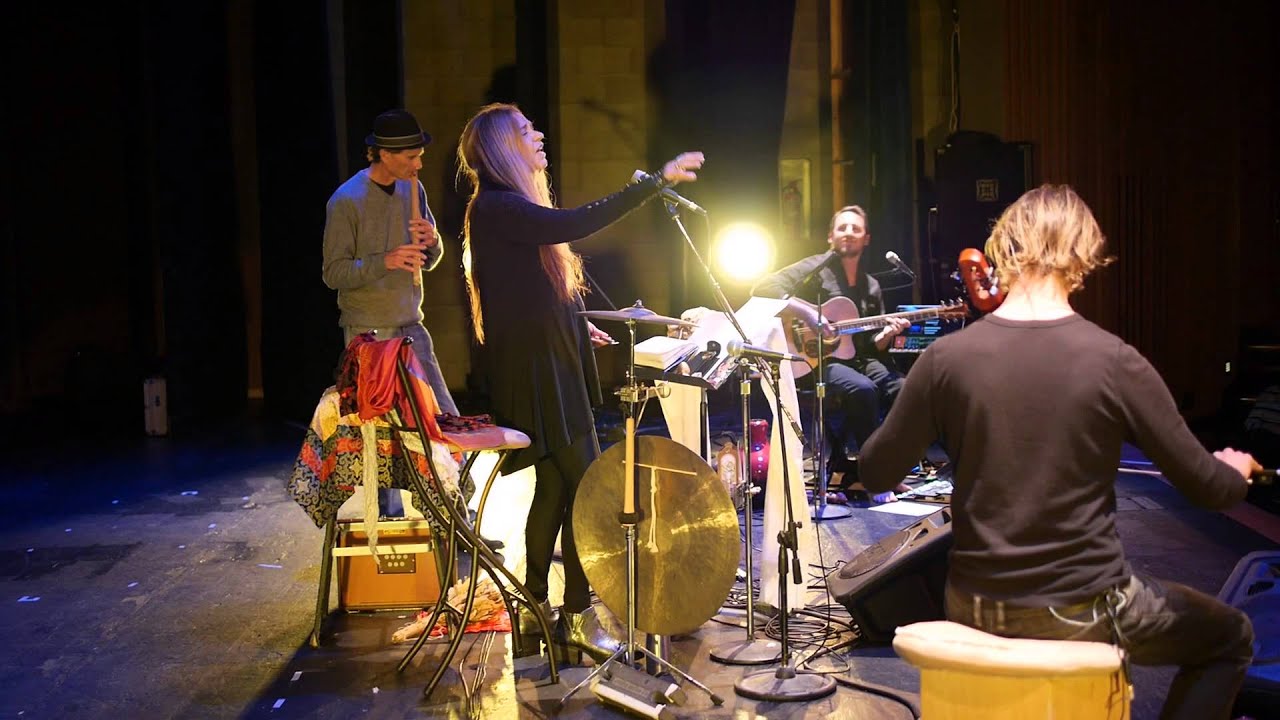
In a three-minute sonic landscape, something impossible unfolds: the attempt to capture light itself as sound. Not metaphorically, but sonically—the actual quality of unbounded space, of clouds catching and refracting sun. This is "Liminal Rays," from Grammy-nominated artist Silvia Nakkach's album Liminal, an ambient work that operates in the spaces between definition, between form and formlessness, between what we see and what we hear.
The word carries weight in philosophy and anthropology: liminal refers to threshold spaces, the in-between states where transformation occurs. A doorway. A sunset. The breath between exhalation and the next inhale. In ritual traditions, liminal space is sacred ground where old structures dissolve and new ones can be imagined.
Nakkach's album translates this concept into sound. The work is described as conveying "a sense of unbounded space and light, with original music not attached to any particular form." This is not ambient music as mere background texture. This is ambient music as gateway—to stillness, to the spaces between thoughts, to the quality of light itself.
By abandoning conventional song structure entirely, Nakkach creates space without form. There are no verses, no choruses, no repeated melodies anchoring the ear to recognizable architecture. Instead, the piece unfolds like the atmosphere itself—layered, diffuse, without clear beginning or end.
Liminal is explicitly "inspired by the mysterious light and beauty of clouds." This artistic ambition contains an inherent impossibility: clouds have no fixed form, no melody, no rhythm. They exist in states of constant transformation. Yet here, Nakkach attempts to set that to music, to capture the quality of light refracting through water vapor.
"Liminal Rays" specifically is described as "an ode to the sun...If we could listen to it." The phrase contains a paradox: the sun, by definition, is silent. Its light is visual. Yet an artist renders that experience through voice, through strings, through the physics of sound waves. The impossibility is intentional.
Abandoning representation, Nakkach instead captures essential qualities: diffusion, layering, the absence of edge. The cloud-inspired landscape does not imitate clouds but embodies what they are—transformation without form, beauty without structure, presence without assertion.
Silvia Nakkach is a Grammy-nominated artist working at the intersection of voice, spirituality, and sound design. Her collaborators on "Liminal Rays" bring distinct instrumental voices: Todd Boston on lapsteel and as the album's producer, and David Darling on cello layers.
The lapsteel—an instrument that transforms sound through the physics of string, metal, and resonance—becomes here another voice in an undifferentiated sonic space, freed from its conventional context. The cello similarly becomes a medium for sustained, shimmering textures rather than a purely melodic voice. The human voice of Nakkach merges with these instruments not as separate characters in a drama, but as elements dissolving into unified atmosphere.
What matters is not the individual virtuosity of these instruments but their dissolution into a unified whole. The piece is not a showcase; it's a unified sonic field in which voices lose their individual character and merge into something larger, more impersonal, more vast.
At 1:30 into the piece, something emerges: the Sanskrit vowel "आ" (A), one of the most fundamental sounds in yoga and Vedic traditions. In Sanskrit phonology, this is understood as a primordial sound. In yoga practice, this vowel grounds and centers the practitioner's energy.
But here, in the context of Nakkach's ambient soundscape, the vowel becomes simply another element in the texture—not a teaching, not a mantra in the traditional sense, but a sonic component. A human voice merging with cello, lapsteel, and the undefined harmonic space they have created together. It's a reminder that Nakkach's work, while contemporary and experimental, maintains a lineage to spiritual sound practices, to the understanding that voice itself is a vehicle for transformation.
The description's crucial phrase signals a fundamental artistic choice. In much of Western musical tradition, form is everything. A song has a form. A symphony has a form. These structures give us a sense of where we are in the piece; they create expectation and resolution, narrative arc, dramatic shape.
But Nakkach's Liminal—and "Liminal Rays" in particular—abandons this architecture. Here is music that is not trying to tell you something, persuade you of something, take you on a narrative journey. Instead, it attempts to embody a quality: the quality of unbounded space, of light, of the threshold itself. It invites the listener to inhabit a state rather than follow a story.
This approach demands something different from the listener—not passive consumption but active listening, a willingness to sit in undefined space and allow sound to shape consciousness rather than consciousness shaping what it expects to hear.
There's an inherent paradox in what Nakkach is attempting: she uses form (music, voice, instruments) to evoke formlessness. She uses sound (temporal, unfolding in time) to suggest light (instantaneous, filling space). She uses the voice—the most intimate human instrument—to capture something impersonal and cosmic.
Yet this paradox is precisely where the work gains its power. The "ode to the sun" is an ode precisely because the sun cannot hear it, cannot be reached by it. The cloud-inspired ambient landscape works precisely because it abandons the impulse to literally imitate clouds and instead captures their essential quality: diffusion, layering, transformation, the absence of permanent edge.
In liminal space, opposites coexist without resolution. The sacred "A" and the lapsteel. The cello and the void. The attempt to capture the uncapturable. And in that coexistence, something becomes possible—not an answer, but an opening.
The Liminal album operates as a unified sonic environment rather than a collection of individual tracks to be selected or skipped. The work functions as a continuous landscape—one that shifts and evolves but maintains a consistent quality of boundless space and light. Each composition contributes to an overall atmosphere inspired by clouds and light, where traditional song structures dissolve into pure sound and texture.
This is music designed for presence rather than distraction, for inhabitation rather than entertainment. It asks the listener to enter the space between states, to sit in the threshold, to allow the boundaries between self and sound to blur.
Listen to Liminal in full. The work is available on iTunes, Bandcamp, CDBaby, and Amazon. Pay attention not to individual instrumental lines but to the overall texture—how it shifts, how it contains depth despite its apparent simplicity. Notice the quality of space in the recording itself; this is a piece with reverb and distance built into its DNA, a work composed not just of what you hear but of the silence and space surrounding it.
Explore other artists working at the intersection of spiritual sound practice and contemporary composition—those asking similar questions about how the ineffable, the invisible, the immaterial can be captured and rendered in sound. Seek out music that prioritizes atmosphere and presence over narrative or entertainment.
And return to the original question the piece poses: If you could listen to the sun, what would you hear? What would the voice of light sound like? What does unbounded space sound like? Nakkach's Liminal Rays offers not an answer, but an invitation to sit in that threshold space and listen.