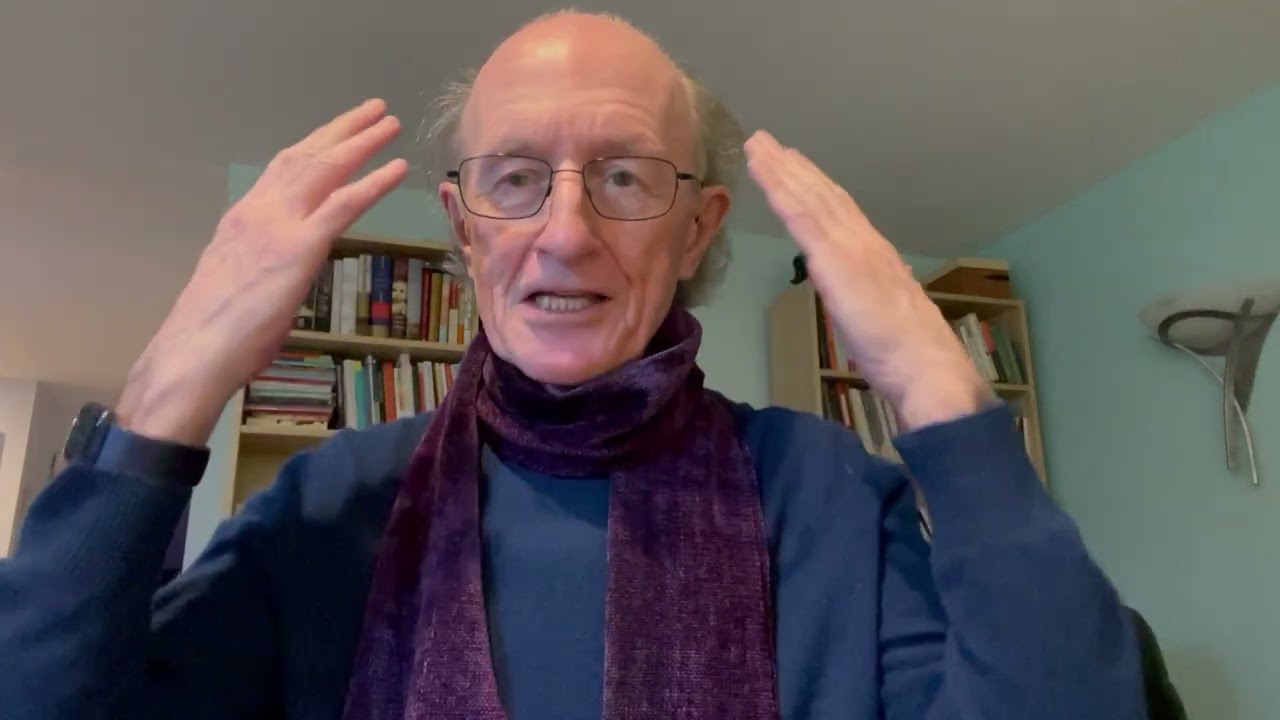
On a spring evening in Charlottesville, Virginia, a meditation teacher enters a room and opens not with instruction, but with an invitation: Do not try to save the whole world or do anything grandiose. Instead create a clearing in the dense forests of your life and wait there patiently until the song that is yours alone to sing falls into your open cupped hands. These are not the teacher's words. They belong to poet Martha Postlethwaite, and by reading them aloud 14 minutes into a guided meditation session, Hugh Byrne—co-founder and guiding teacher of Insight Meditation Community of Washington DC—has just performed a subtle act of alchemy. He has smuggled metaphor past the vigilant, conceptual mind to plant it directly in the body, in the heart, in the space of stillness where meditation actually happens.
This is Byrne's signature move. Where many teachers build meditation around breath counting or body scans alone, he constructs an architecture that holds silence, physical guidance, poetic language, and metaphorical contemplation in careful balance. Poetry is not decoration or inspiration in his method. It functions as technology—a tool to dislodge attention from habitual thinking patterns and anchor it in the present moment with the force of image and language that the logical mind cannot easily argue with.
Early in the session, Byrne states his philosophy plainly: "I like to do is incorporate some poems and poetry in there because I think that there can help us to kind of drop out of our conceptual mind a little and kind of drop down into the present." This is not subtle or accidental. The conceptual mind—that relentless narrator constantly planning, remembering, problem-solving, judging—is precisely what stands between a person and the direct experience of being alive right now. A teacher can tell someone to "be present" a hundred times; the conceptual mind simply adds this new instruction to its to-do list. But poetry bypasses that gatekeeper. A well-chosen image, held in the body and mind simultaneously, creates a kind of productive confusion that stops the machinery of thinking just long enough for something else to emerge.
Byrne structures his session with equal parts meditation guidance, periods of silence, and poetic interludes. The pacing matters. After leading practitioners through foundational work—settling into posture, grounding attention in the body, inviting calm through breath—he introduces Martha Postlethwaite's "Clearing" not as something to think about, but as something to sink into. The poem speaks directly to the work at hand: the creation of inner space through withdrawal from the grandiose, the urgent, the compulsive. By the time he repeats the final lines—only then will you know how to give yourself to this world so worthy of rescue—the listener has already done the work of understanding through felt experience rather than intellectual parsing.
Before the poetry lands, Byrne establishes what might be called the physical grammar of meditation. He begins with posture: sitting grounded, upright, relaxed. Back straight, shoulders soft, hands resting comfortably. This is not casual. The body is the first anchor, the first thing the mind can return to when it drifts into abstraction. He invites practitioners to close their eyes or maintain a soft, unfocused gaze—and notably, he offers both options without judgment. Meditation is not a performance standard; it is a practice that accommodates different nervous systems and preferences.
Then comes the breath work, delivered with precision and warmth. "If you've had to hurry or had a busy or intense day, it's helpful to just take a nice deep in breath filling the chest filling the lungs releasing on the out-breath." He guides two or three deeper breaths, then introduces a subtle verbal anchor: breathing in, he suggests quietly saying "calm" to oneself; breathing out, repeating it. This is not affirmation in the New Age sense. It is language used as a somatic tool, pairing a word with the body's actual experience of settling. The exhale naturally slows and lengthens; the inhalation becomes deeper; the association between the word and the felt state becomes embodied rather than intellectual.
What follows is a gentle body scan—an invitation to let attention drift through the facial muscles, the eyes, the jaw, the shoulders, the torso. Byrne uses the language of invitation and permission rather than command: "See if there's any area that might relax and soften a little bit more." This matters. The practice is not about forcing the body into relaxation, but noticing where it is already willing to release. He even suggests inviting "a slight smile to your face—enough of a smile to activate the muscles at the corners of the eyes and the corners of your mouth." This small gesture accomplishes multiple things: it signals to the nervous system that there is no threat, it engages the vagal pathways that calm the body, and it becomes an expression of how one wishes to meet whatever arises in the meditation.
Midway through the meditation, after the body has settled and attention has found some stability, Byrne introduces one of the most powerful metaphors in contemplative literature: Rumi's "The Guest House." He sets it up first: "See if you can meet whatever you're experiencing as though the guests coming to visit." Then the poem itself unfolds: Even if they're a crowd of sorrows who sweep your house empty of its furniture still treat each guest honorably. He may be clearing you out for some new delight.
This metaphor is not meant to be pleasant. A crowd of sorrows sweeping your house empty is not a cheerful image. And that is exactly its power. Byrne is teaching practitioners to meet difficult emotions, bodily pain, and unwanted thoughts not with resistance or suppression, but with a kind of honorable hospitality. This is not toxic positivity; it is radical acceptance grounded in the understanding that even what we call negative experience may be serving some purpose we cannot yet see. By embedding this teaching in Rumi's 13th-century Persian poetry, Byrne avoids the trap of making it sound like his own bright idea. It carries the weight of centuries and the authority of lived wisdom.
In the technical heart of the meditation, Byrne teaches the foundational practice of return. He introduces breath as an anchor—what he calls "a home base that we can rest the attention in and then come back to when the mind does drift into thoughts." This is where the real work begins. He acknowledges plainly: "The mind moves easily into thoughts plans memories." This is not a failure. This is simply what minds do. He offers specific anchors—the cool air entering the nostrils, the chest and belly rising and falling, the overall cycle of the breath. The practitioner is invited to notice where the breath is most noticeable or predominant for them, without trying to manufacture a particular experience.
What makes Byrne's instruction here particularly skillful is his frame for what happens when the mind wanders: "Just gently and kindly let your attention come back. Not to make a problem out of thinking, recognizing that the mind produces thoughts like a healthy tree produces leaves." This reframe is crucial. The mind produces thoughts the way trees produce leaves. It is not a character flaw; it is function. There is nothing to fix. Every time you notice you have wandered and come back, you are not failing at meditation—you are succeeding at it. This inverts the shame that many practitioners carry into formal practice and makes the work fundamentally about kindness.
He deepens this by suggesting that if someone is experiencing bodily discomfort or challenging emotions, they might "put a hand on the heart or on the belly or both" and "send yourself a message of kindness: may I be happy, may I be at peace, or I care about this suffering." Here, the practice becomes explicitly relational. You are not standing apart from your suffering, judging it or trying to transcend it. You are turning toward it with the tenderness you would offer a friend in pain. This is not sentimental; it is precise. It teaches that meditation is not escape. It is a form of loving presence turned toward whatever is actually present.
As the meditation nears its close, Byrne offers one final poem—this time by Wendell Berry: When despair for the world grows in me and I wake in the night at the least sound in fear of what my life and my children's lives may be, I go and lie down where the wood Drake rests in his Beauty on the water and the great Heron feeds. I come into the Peace of wild things who do not tax their lives with forethought of grief.
This is not escape into nature mysticism. It is recognition that despair and fear are real, that they wake us in the night, and that there is a remedy available: the capacity to sense into a kind of peace that is not the absence of difficulty but the presence of something larger, wilder, and less burdened by human foreknowledge. The wild things do not grieve the future; they are free from that particular human torture. By opening to this freedom, even temporarily, something in the nervous system resets. Meditation becomes not a technique to fix yourself, but a gateway to a different way of being in the world.
This approach to meditation—one that holds poetry, embodied practice, and kindness together—is not unique to Hugh Byrne, but his particular weaving of these elements offers a model for anyone seeking to deepen a personal practice or teach others. To explore further, seek out teachings that integrate contemplative practice with literary and poetic traditions. Learn the poems Byrne uses—read the full texts of Postlethwaite, Rumi, and Berry outside the meditation context, and notice how meaning shifts when encountered through both intellectual and meditative channels. Consider how your own body might become a more reliable anchor than your thinking mind. And practice the radical permission he offers: that the mind producing thoughts is not a problem to solve, but simply how minds work. Every return to breath, every gentle coming-back, is the meditation itself.