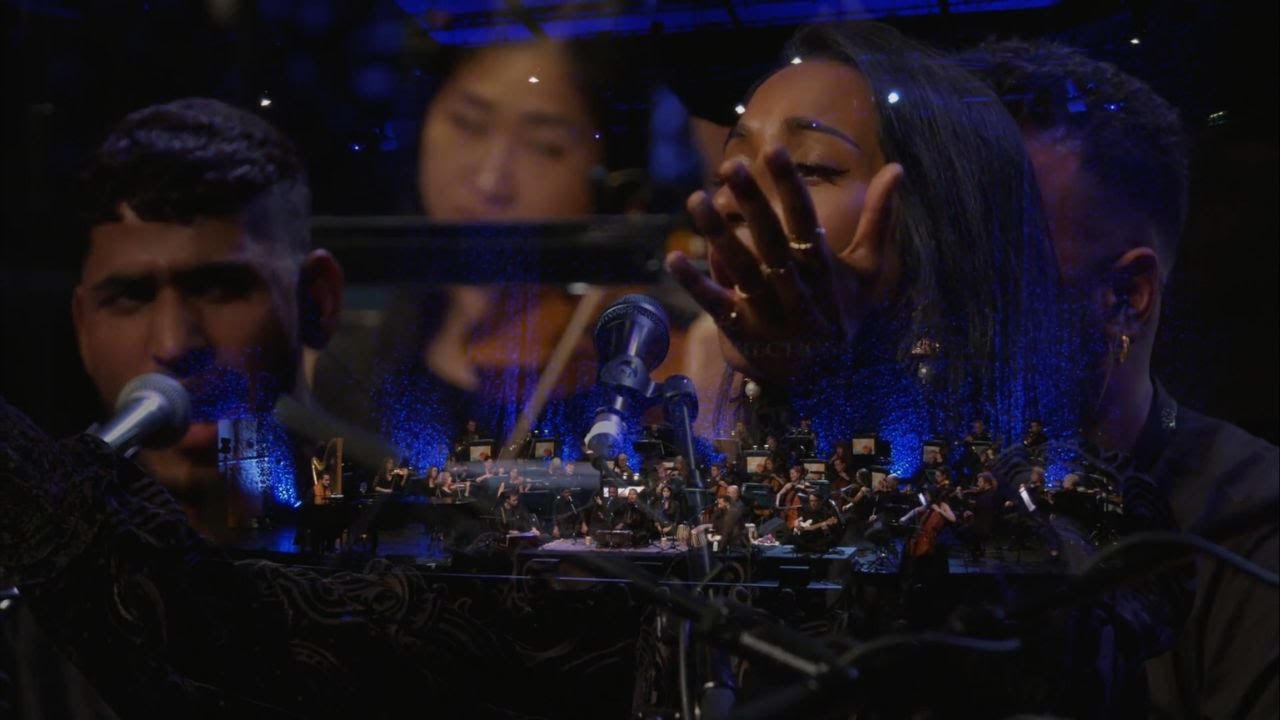
Man Kunto Maula is a devotional Qawwali composed by the 13th-century Sufi poet Amir Khusrao, performed here in an orchestral arrangement that weaves traditional tabla, harmonium, and voices with Western strings (violin, cello). The piece honors Imam Ali through both explicit invocation ("Whomever I am master to, Ali is his Master too") and abstract mystical chanting, creating a bridge between Islamic devotion and Sufi transcendence. This orchestral Qawwali draws on centuries of Sufi practice while modernizing its instrumentation for contemporary listeners.
What is Qawwali and why does Man Kunto Maula matter?
Qawwali is a form of Sufi devotional music that emerged in the Indian subcontinent, originally performed in shrines and spiritual gatherings. Unlike conventional religious chanting, Qawwali aims to induce spiritual states through repetition, melodic intensity, and call-and-response structure. Man Kunto Maula, composed by Amir Khusrao in the 13th century, is one of the most enduring pieces in the Qawwali repertoire. Its central couplet—"Whomever I am master to, Ali is his Master too"—expresses a core Sufi principle: that temporal authority means nothing without spiritual alignment. The composition has been performed for over 700 years, passed down through living oral traditions and now reimagined through orchestral arrangement.
The piece's significance lies in its dual nature. On the surface, it praises Imam Ali through martial and divine titles: "King of the brave, the Lion of God, The Strength of the Lord." Yet deeper within, it transitions into abstract mystical chanting—syllables like "Tanana," "Yalali," and "Dara Dil E Dar"—that move beyond linguistic meaning into pure sonic devotion. This is Qawwali's essential method: language gives way to vibration, intellect to direct experience.
How does the orchestral arrangement bridge East and West?
This version, arranged and produced by Rushil, combines traditional South Asian instruments with a Western orchestral string section. The tabla (hand drums) played by Amrit Dhuffer provide the rhythmic pulse; the harmonium by Fram Karbhari anchors the melodic foundation; and Abi Sampa's vocal delivery carries both the lyrical content and the mystical chants. Layered over this foundation are violin, cello, and additional violins—instruments associated with European classical music.
Rather than diluting the Qawwali form, this fusion expands its reach. The orchestral strings create harmonic depth that resonates with listeners accustomed to Western concert music, while the tabla and harmonium maintain the piece's spiritual roots. The arrangement demonstrates that Qawwali, despite its historical specificity, speaks to universal human experiences: longing, surrender, and the seeking of higher authority beyond the self. The careful mixing and mastering work (by Chris Cara and Alex Psaroudakis) ensures that no single element overwhelms another—the vocals remain the spiritual center, the orchestra their reverberant halo.
What do the lyrics reveal about Sufi devotion to Imam Ali?
The opening verses invoke Imam Ali through multiple titles and attributes. "Shah-E-Mardaan" (King of the Brave) and "Shair-E-Yazdaan" (Lion of God) position him as both a martial and divine figure. "Qoowwat-E-Parwardigaar" (The Strength of the Lord) suggests that Ali's power flows directly from God, not from his own ambition. The couplet "La Fata illa Ali, La Saif illa Zulfiqaar" (There is no one like Ali, There is no sword like Zulfiqaar) references both his spiritual uniqueness and his legendary sword, collapsing the distinction between external heroism and internal mastery.
The central verse, "Man Kunto Maula, Fa haza Ali-un Maula" (Whomever I am master to, Ali is his Master too), is the theological heart. This statement, historically attributed to the Prophet Muhammad at Ghadir Khumm, asserts that all authority—spiritual and temporal—ultimately derives from Ali's station. In Sufi interpretation, this means: your ego, your will, your sense of control are all ultimately subject to a higher reality represented by Ali. The listener is invited not to obey Ali as a historical figure but to surrender to the spiritual principle he embodies.
How does the abstract chanting deepen the mystical experience?
After the lyrical invocations, the piece enters a realm of syllabic mysticism. Phrases like "Dara Dil E Dara Dil E Dar E Dani" (Enter into the heart, Enter into the heart, Melt therein) shift from instruction to incantation. The repetitive "Tanana Nana, Tana Nana Ray" and "Yalali Yalali ala, Yala Ray" have no literal meaning—they are sonic mantras designed to penetrate the thinking mind and activate direct awareness.
This is distinctly Sufi method. Rather than asking the listener to believe in something intellectually, Qawwali uses rhythm and melody to bypass conceptual understanding. The tabla's pulse, the rising and falling of the vocal line, the harmonic support of the orchestra—all these elements work together to create a neurological and emotional state conducive to spiritual experience. The chanting becomes a form of prayer that operates below language, directly affecting the heart (which in Sufi philosophy is the organ of spiritual perception, not sentiment).
The English translation provided—"Enter into the heart, Enter into the heart, Melt therein, You and me, Sing inside in sweet melody"—gives a window into the phenomenological goal: a dissolving of boundaries between self and other, performer and listener, the chanter and the Beloved. "You and me" becomes one entity; singing "inside" means the melody internalized, vibrating in the subtle body rather than merely heard by the ear.
What is the significance of the closing invocation?
The final verses return to direct address: "Haider-E-Um Qalandaram Mastam, Banda-E-Murtaza Ali Hastam" (A Haidari [Haidar is a title for Imam Ali which means Golden], a mystic drowned, I am the slave of Murtaza Ali). Here, the singer claims identity not as an autonomous individual but as a servant—a "banda"—of Ali. This is radical in a spiritual sense: the ego dissolves into service. "Mastam" (drowned, intoxicated) describes the state of fana, or annihilation of self in Sufi terminology. The mystic is "drowned" in Ali, meaning dissolved in that principle of spiritual mastery.
"Peshwa-E-Tamaam Rindanam, K Sag-E-Koh-E-Shair-E-Yazdanam" (Leader of all the renegades, Dog of the mountain of the Lion of God) employs paradoxical language typical of Sufi poetry. The speaker claims to be both a leader and a dog, both exalted and abased. In Sufi terms, this paradox resolves: one is a leader precisely because one has become as humble as a dog, deriving all authority from serving the divine principle. The "mountain of the Lion of God" is Ali himself, the immovable, eternal reality to which all else is subordinate.
The repetition of "Ali Maula, Maula Ali Maula" in the final moments returns to the core mantra—Master is Ali, Master is Ali. This cyclical ending suggests that the piece could continue indefinitely, the invocation inexhaustible. In live Qawwali performances, this section often extends for many minutes, with the assembled listeners entering collective states of spiritual elevation.
How does this orchestral interpretation honor the original while reaching new audiences?
Amir Khusrao lived in the 13th century, centuries before the orchestral instruments heard here were integrated into South Asian musical life. Yet the arrangement respects the core of his composition: the text, the devotional intent, the harmonic relationship between voices and accompaniment. By adding strings without overshadowing the tabla and harmonium, the musicians honor both lineages—the centuries-old Qawwali tradition and the musical consciousness of listeners shaped by global, cosmopolitan soundscapes.
This is not a "modernization" that betrays the original; rather, it is an extension of Qawwali's own logic. Qawwali has always adapted to the instruments and sensibilities available in its context. Amir Khusrao himself innovated, bringing new poetic and musical sophistication to Sufi devotion. The orchestral Qawwali continues that precedent, reaching listeners who might never enter a shrine or attend a traditional Qawwali gathering but who are nevertheless hungry for spiritual transmission. The video direction by Andrew Britton (Limelight Films) and the professional production quality signal that this is not a documentary artifact but a living practice.
Where to go from here
If you are moved by this piece, explore the broader world of Qawwali through artists who have carried the tradition into contemporary forms. Listen to recordings of Man Kunto Maula performed by traditional Qawwali groups (such as Nusrat Fateh Ali Khan, if you wish to hear the form in its more classical vocal-and-percussion rendering) to sense the differences in approach. Study the poetry of Amir Khusrao and other Sufi poets, both to deepen your understanding of the texts and to discover how mystical philosophy was encoded in verse.
If you are drawn to the orchestral fusion model, seek out other contemporary Qawwali and Sufi music projects that blend traditional and modern instrumentation. Consider attending live Qawwali performances, which transmit something that recordings cannot—the collective field generated by a room of listeners in spiritual attunement, the spontaneity of the performers' response to that energy. Finally, if the spiritual principles embedded in these lyrics resonate with you, study Sufi philosophy and practice directly, either through books or under the guidance of a qualified teacher, so that the poetry becomes not merely beautiful language but a map of inner transformation.