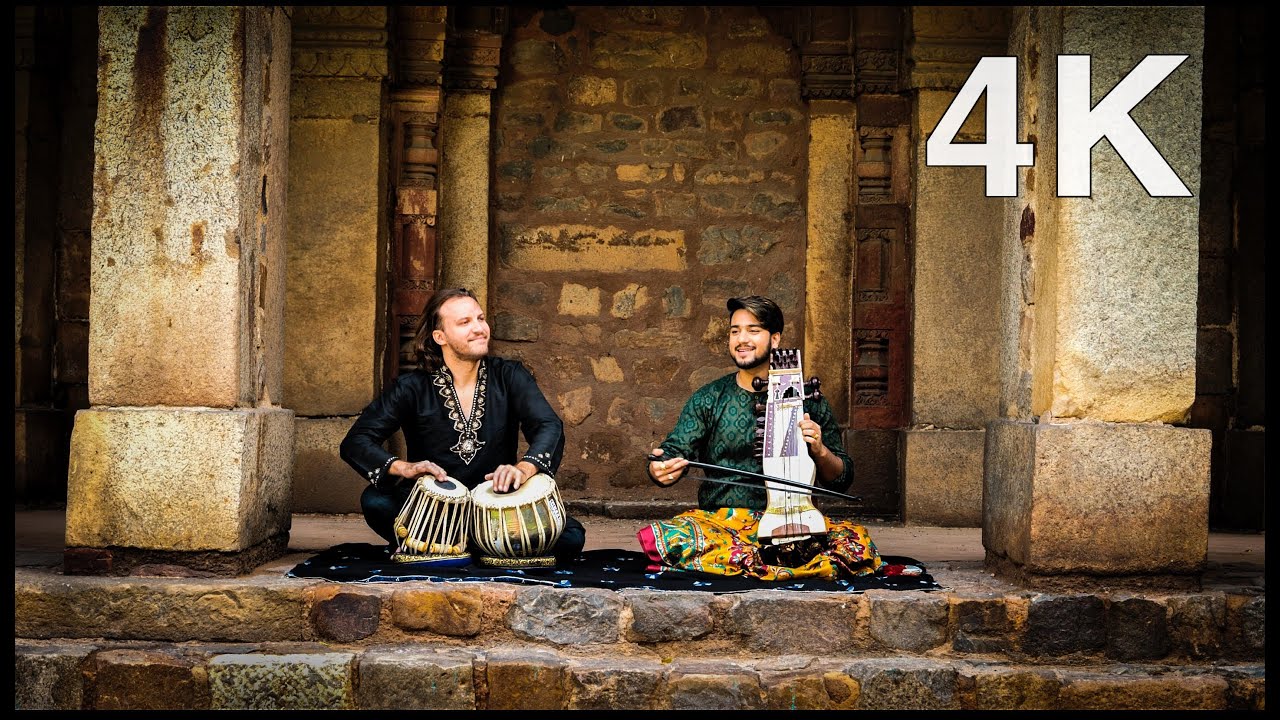
This 26-minute concert performance captures Purbayan Chatterjee (sitar) and Denis Kucherov (tabla) exploring Raga Kedar through the classical Hindustani structure of alap, jhor, and jhala. Recorded at Saint Petersburg State Academic Capella during the 2018 International Festival Sitar, the performance demonstrates how melodic development unfolds across these distinct phases, with the sitar's long-form improvisational foundation gradually accelerating into rhythmic complexity as the tabla enters and intensifies the conversation.
What is Raga Kedar and why is it significant in Hindustani classical music?
Raga Kedar is a classical raga with deep roots in the Hindustani tradition. It belongs to the Bilaval thaat (modal framework) and is characterized by specific ascending and descending patterns that give it a particular emotional and melodic flavor. The raga has historically been performed in both khayal and dhrupad vocal traditions, as well as in instrumental forms. When played on the sitar—an instrument capable of sustained melodic development and subtle microtonal inflections—Raga Kedar's characteristics can unfold over extended periods, allowing the performer to explore the raga's inner landscape in considerable detail.
The choice of this raga for a concert performance reflects both its pedagogical importance (it is studied extensively by sitar students) and its expressive depth. The raga's structure provides enough flexibility for improvisational exploration while maintaining a clear identity, making it suitable for both demonstrating technical command and creating meaningful musical dialogue between instruments.
How does the alap-jhor-jhala structure shape this performance?
The alap-jhor-jhala progression is the foundational architecture of many Hindustani instrumental performances. Each phase serves a distinct musical and rhythmic function:
- Alap: The opening section, performed without rhythmic accompaniment or tabla. The sitar explores the raga's scale, characteristic phrases (mukhras), and ornamental patterns (gamaks) in a free, unmeasured manner. This phase allows the soloist to establish the raga's personality and invite the listener into its world. The alap can last several minutes in concert performances.
- Jhor: A transitional phase in which rhythmic momentum begins to emerge, though the tabla has not yet fully entered. The sitar's phrases become more organized and faster-paced, building anticipatory energy. This bridge between the meditative alap and the rhythmically engaged jhala allows both performer and listener to sense the approaching rhythmic framework.
- Jhala: The climactic phase, in which the tabla enters with full rhythmic support and the sitar accelerates into rapid, virtuosic passages. The jhala typically features fast scalar runs (taans), complex rhythmic interplay between melody and percussion, and a heightened sense of musical intensity. This phase demonstrates the performer's technical facility and their ability to navigate both melodic and rhythmic complexity simultaneously.
In this performance, this three-part progression allows viewers to witness how a single raga unfolds across different temporal and rhythmic scales. The listener moves from contemplative, spacious exploration into increasingly energetic and technically demanding territory.
What role does the tabla play in dialogue with the sitar?
The tabla (a pair of hand drums) serves as both timekeeper and conversation partner in Hindustani classical music. Once the tabla enters during the jhala section, it does more than simply maintain a rhythmic pulse. The tabla player responds to the sitar's phrases, answers melodic figures with rhythmic patterns, and creates tension and release through the interaction of two independent but complementary musical voices.
Denis Kucherov, the tabla player in this performance, must listen acutely to Purbayan Chatterjee's sitar and anticipate where the melodic phrases are heading. The tabla's entry during the jhala intensifies the musical texture, and the two instruments begin to trade leadership. Sometimes the sitar drives the momentum forward with rapid taans (melodic runs), and the tabla responds by anchoring or complicating the rhythmic ground. Other moments reverse this relationship, with the tabla's rhythmic patterns pulling the sitar into new improvisational territory. This call-and-response dynamic is central to the aesthetic of Hindustani classical music and distinguishes it from many other musical traditions.
How does the sitar's technique express the raga's identity?
Purbayan Chatterjee, one of India's leading contemporary sitar performers, brings particular expressive techniques that are essential to how Raga Kedar's character emerges in performance. The sitar's technique includes:
- Bending and sliding between notes (meend): Rather than striking discrete pitches, the sitar player often slides or bends between notes, creating a vocal-like quality. This microtonal flexibility allows the performer to emphasize certain notes and create emotional intensity.
- Rapid ornamentation (gamak): Quick, pulsing movements around a central note that add texture and life to the melodic line.
- Sustained tone and resonance: The sitar's sympathetic strings vibrate in response to the played strings, creating a shimmering resonance that supports long, meditative passages during the alap.
- Rhythmic precision during jhala: As the performance accelerates, the sitar player must execute rapid scalar passages (taans) with both rhythmic accuracy and melodic clarity, requiring significant technical command.
These techniques are not merely decorative; they are how the raga's specific emotional and melodic identity is communicated. Each raga has preferred ways of articulating its notes, characteristic phrases that recur, and specific emotional associations. Through the sitar's expressive vocabulary, Raga Kedar's particular identity is revealed to the listener.
Why does this concert matter in the context of global classical music exchange?
This performance, recorded in Saint Petersburg as part of the International Festival Sitar, represents an important moment in the global spread of Hindustani classical music. Purbayan Chatterjee, based in India, and Denis Kucherov, a Russian tabla player, coming together in Russia to perform classical Indian music, demonstrates how these traditions are now being studied, practiced, and celebrated across geographical and cultural boundaries.
The festival's name and location emphasize the transnational nature of contemporary classical music practice. While Hindustani classical music originated in the Indian subcontinent, its deep structures and expressive possibilities have attracted musicians worldwide. Russian and European musicians have increasingly dedicated themselves to mastering these traditions, studying in India, collaborating with Indian masters, and bringing the music to new audiences. This internationalization does not dilute the tradition; rather, it extends the lineage and creates new contexts for its continued evolution.
The concert setting—at the Saint Petersburg State Academic Capella, a prestigious venue—also signals that Hindustani classical music is being presented alongside European classical music within institutional frameworks. This positioning affirms that sitar and tabla performance is understood as a serious, complex, and worthy form of artistic expression worthy of concert hall presentation, not merely as folk music or exotica.
Where to go from here
If you are interested in deepening your engagement with Hindustani classical music after watching this performance, consider exploring recordings of other ragas to develop your ear for how different ragas have distinct characteristics within the same instrumental tradition. Listen to multiple performances of Raga Kedar by different artists to understand how individual interpretations vary while the raga's core identity remains recognizable. Study the work of Purbayan Chatterjee through his other recordings and performances to see how he approaches various ragas and compositional forms. Learn about the tabla tradition more broadly by seeking out recordings featuring prominent tabla soloists and exploring how rhythm and melody interact across different musical contexts. If possible, attend live Hindustani classical music concerts in your region, as the immediate presence of the instruments and the spontaneous nature of the improvisation create an experience that recordings cannot fully capture.