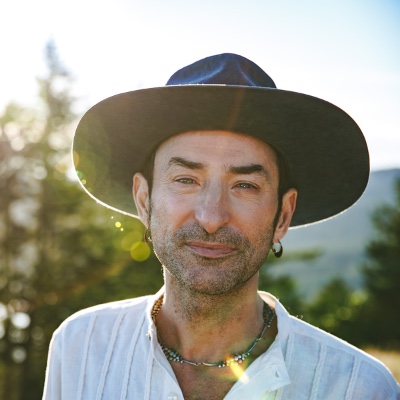
This is a live studio performance of "Hallelujah" featuring singer Rafe Pearlman and electric kora player Daniel Berkman, recorded at the Pyramid House. The performance stands out for its extended improvisational introduction and an unexpected key change to F major that required Pearlman to adapt in real time—a musical moment that exemplifies the spontaneity and creative risk-taking at the heart of live instrumental and vocal collaboration.
This live performance of "Hallelujah" departs from conventional studio versions by embracing spontaneity and real-time adaptation. Rather than following a predetermined arrangement, Rafe Pearlman and Daniel Berkman constructed the piece around an extended improvisational introduction before moving into the song proper. This approach privileges the interplay between vocalist and instrumentalist, allowing each musician to respond to the other's phrasing and energy in the moment rather than executing a fixed template.
The most significant creative gesture in the arrangement is the key change. Berkman, playing electric kora, threw the composition into F major—a departure from the more common keys in which "Hallelujah" is typically performed. This wasn't predetermined; it emerged organically during the session. For Pearlman, singing "Hallelujah" in F for the first time required immediate vocal adjustment and flexibility. Rather than interrupting the flow to reset, he navigated the unexpected tonal shift, demonstrating the kind of adaptability that characterizes experienced ensemble musicians.
The electric kora, an amplified version of the traditional West African harp-like string instrument, brings a distinctive tonal character to this arrangement. Unlike acoustic guitar or piano, which dominate many versions of "Hallelujah," the kora's bright, plucked timbre creates a more textured, rhythmically complex foundation. Berkman's use of the electric kora suggests an interest in blending contemplative, devotional music (the song's spiritual register) with world music instrumentation, creating a sonic space that feels both intimate and expansive.
The electric amplification allows the kora's details—the subtle decay of each note, the resonance across its strings—to register clearly in a live setting. Rather than serving as mere harmonic accompaniment, the instrument functions as a melodic and textural partner to Pearlman's voice, suggesting shared compositional responsibility rather than a standard vocalist-plus-accompaniment hierarchy.
The extended improv intro serves multiple functions. First, it establishes a shared sonic and emotional foundation between the two musicians before the familiar lyrics and melody arrive. Listeners hear Pearlman and Berkman finding each other's rhythms, testing dynamic range, and building trust through instrumental conversation. This extended foreground of pure musicianship—no lyrics, just voice and strings—draws attention to the quality of listening and response that underpins the entire performance.
Second, the improvisation signals to the audience that this is not a reproduction of a recorded arrangement, but a one-of-a-kind event. The stakes are raised slightly; there's a subtle risk in real-time music-making that doesn't exist in performances where every detail has been rehearsed and locked in. This vulnerability is often where the deepest listening happens, both from the musicians and from those bearing witness.
The decision to perform "Hallelujah" in F major, rather than its more common keys, highlights several aspects of vocal music-making. First, key choice directly affects a song's emotional color and its relationship to a singer's vocal range. A key that sits naturally in one vocalist's range may feel strained or lie awkwardly in another's. By choosing F, Berkman may have been testing the upper or lower boundaries of Pearlman's voice, or simply introducing a harmonic color that felt right for the moment.
More importantly, Pearlman's willingness to sing in a key he had not previously explored with "Hallelujah" demonstrates a crucial distinction between interpreting a song and being bound by precedent. Many singers develop a single "correct" key for a piece and perform it identically each time. Here, Pearlman approaches the tune with flexibility, suggesting that the emotional and spiritual content of "Hallelujah" transcends any single tonal center. The song's core—its lyrical and melodic essence—survives and even flourishes when relocated to a new key, provided the vocalist remains present and responsive to the shift.
The Pyramid House appears to have served as a venue or studio space for this recording, suggesting an intimate setting—likely smaller than a concert hall, with acoustics that favor clarity and presence. The presence of a dedicated video producer (Thomas John Holguin) and sound engineer (Jeremiah Holguin) indicates this was a professionally documented performance, not a casual recording, yet the description's conversational tone ("This was a fun rendition") and the admission that Pearlman had never sung the song in F before suggests an informal creative atmosphere. This combination—professional documentation + spontaneous musicianship—is common in the sacred music and kirtan communities, where high production values serve to honor and share spiritual and contemplative music without sacrificing the live, unpredictable energy that gives such music its power.
In many versions of "Hallelujah," the voice carries the song's narrative and emotional weight while instruments provide harmonic and rhythmic scaffolding. In this performance, Pearlman's voice remains the primary carrier of the lyrics and the song's devotional content, but it's framed differently. The extended improvisation positions his singing not as the obvious focal point but as one voice in a larger conversation. When he enters with text, he's joining a dialogue that's already underway, rather than initiating it.
This arrangement also allows the voice to function more as an instrument itself—concerned with tonal color, phrasing nuance, and responsiveness to the kora's movement. The willingness to shift key suggests that Pearlman is thinking of his voice less as a fixed instrument with immutable parameters and more as a flexible medium capable of adaptation and surprise.
Listeners interested in this performance might explore other work by Rafe Pearlman and Daniel Berkman, particularly their collaborative arrangements of sacred and devotional music. The "Hallelujah" rendition exemplifies an approach to spiritual and secular contemplative music that prioritizes live ensemble interaction over pre-recorded fidelity. This aesthetic draws from traditions of kirtan, world music collaboration, and jazz-inflected improvisation—all of which value the real-time dialogue between musicians as essential to the music's meaning and power.
The performance also raises broader questions about how we teach and learn songs: whether mastering a single "definitive" version serves the music, or whether flexibility and willingness to explore new keys, arrangements, and interpretations better honors the song's spiritual and artistic potential. For those making or studying devotional music, sacred singing, or ensemble musicianship, this performance offers a model of how technical skill, creative risk, and collaborative generosity can coexist in a single, spontaneous moment.


