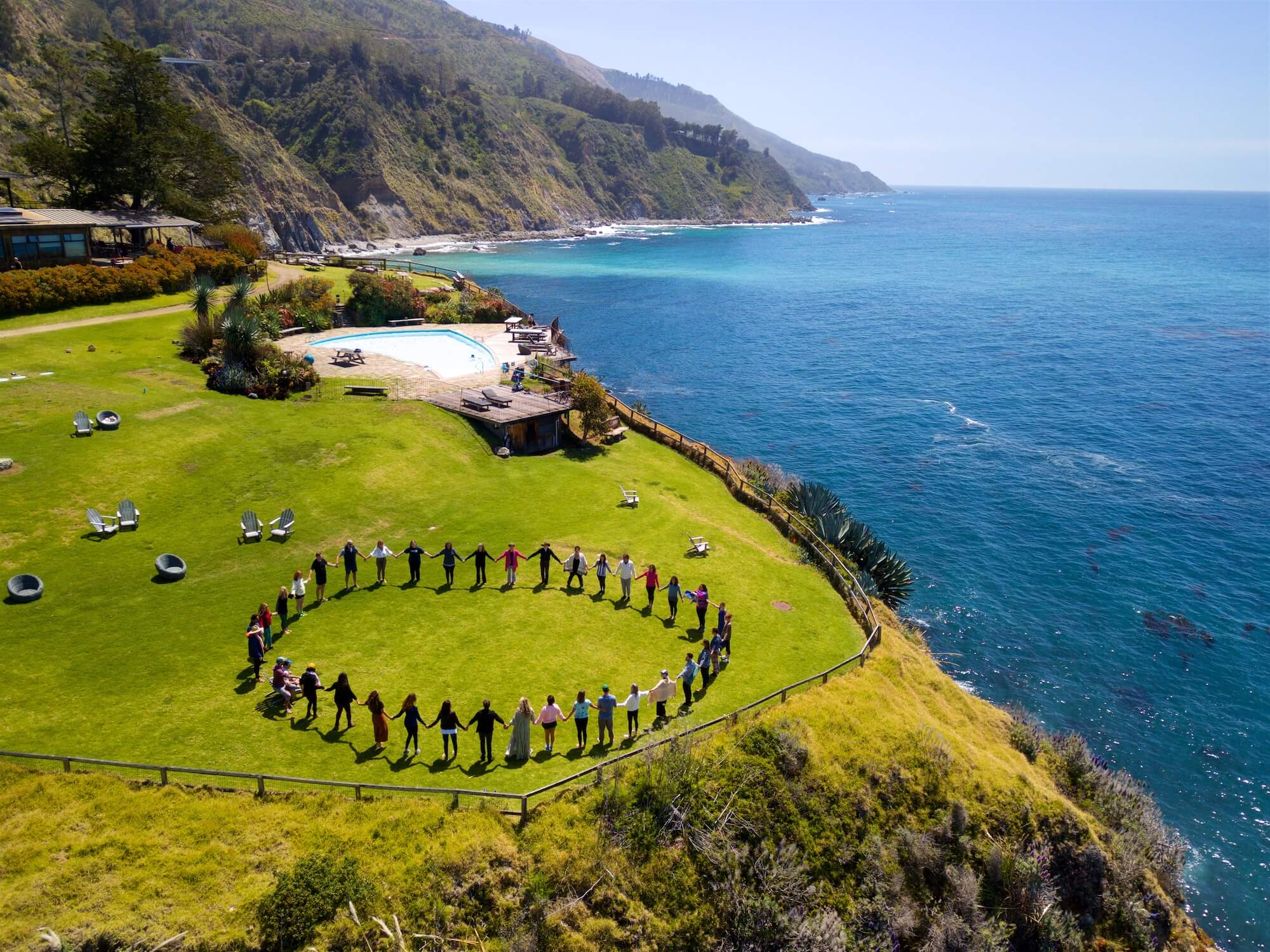
On the California coast where the mountains descend toward the Pacific, where the land itself seems to hold intention, sits an institution that has spent nearly six decades asking a deceptively simple question: what becomes possible when we reconnect with ourselves? Esalen Institute, perched at the convergence of terrain and ocean in Big Sur, represents more than a retreat center. It is the birthplace of the human potential movement—a gathering place conceived not as escape, but as a container for genuine transformation.
The vision animating Esalen operates from a diagnosis of modern disconnection. In the organization's own framing, many of us find ourselves estranged from nature, from community, and—most acutely—from our own bodies. This fragmentation isn't treated as inevitable or irreversible. Instead, Esalen invites a deliberate reunion: of mind with body, of body with spirit, of individual consciousness with the larger landscape of what is possible. The invitation itself carries weight. When reconnection happens, the institute suggests, larger questions begin to surface. Not logistical questions, not ones rooted in fear. Questions about possibility itself—what remains viable beyond the limiting beliefs we've inherited or constructed.
More Than a Retreat: A Laboratory for Ideas
Over 57 years of operation, Esalen has functioned as far more than a destination for workshops and contemplative practice, though those remain central to its work. The institute has served as a gateway for ideas that would reshape cultural conversation: citizen diplomacy, a practice of building understanding across ideological and national divides; integral transformative practices, methodologies that honor the full spectrum of human development—psychological, spiritual, embodied, relational. These concepts did not originate in mainstream institutions. They emerged, were tested, and ripened at Esalen, then moved outward to reshape education, governance, and therapy across the wider world.
The significance of this role cannot be overstated. In an era fragmented by specialization—where the body is the domain of medicine, the mind of psychology, the spirit of religion—Esalen has held the conviction that human wholeness requires integration. The landscape itself reinforces this teaching. The mountains, the sea, the sky: each element visible from the property, each element met without mediation. In Big Sur's geography lies a curriculum that no classroom can replicate.
The Invitation at the Center
Esalen's core offer is not a promise of guaranteed outcome or packaged enlightenment. It is an invitation to come, to explore, and to discover for oneself. This distinction matters. The institute does not claim to deliver transformation; it creates conditions in which transformation becomes possible. Workshop facilitators, the natural setting, the community of seekers gathered for days or weeks—these form a field. What unfolds within that field belongs to the participant. The mystery remains intact. The authority stays with the individual explorer rather than consolidating in the institution or the teacher.
This stance reflects a maturity about the limits of prescriptive spirituality. Esalen does not offer a single path or a unified doctrine. Instead, it operates as what might be called a commons—a maintained space where different approaches to human potential, healing, and awakening can be held, explored, and woven together. A dancer and a neuroscientist, a Sufi poet and a trauma therapist, might meet in the same workshop. Each brings their own lens. Esalen trusts that the meeting itself, in the context of intention and geographical grace, becomes generative.
The scale of the institute's influence becomes visible only when we track the movements that have unfolded in the larger culture. Holistic health, transpersonal psychology, contemplative studies in universities, dialogue across ideological divides—all of these currents have roots in or have been substantially shaped by conversations that began or were deepened at Esalen. Yet the institute itself remains largely under the cultural radar, known more by reputation and by those who have made pilgrimage to Big Sur than by mainstream visibility.
Sacred Land, Open Gathering
The designation of Esalen as both sacred land and gathering place resolves a tension that many spiritual centers struggle with. Sacred typically implies exclusive, set apart, reserved for the initiated. Gathering place implies democratic access, a commons. Esalen holds both. The land has been held by Indigenous peoples for centuries and carries that history in its geology and in the intention that stewards of Esalen have sought to honor it. Simultaneously, the institute opens its doors to thousands annually—to newcomers, skeptics, seekers, researchers, artists. The sacred is not diminished by the open invitation. If anything, it deepens through witnessing, through the cumulative prayer and attention of so many minds and hearts meeting the same landscape.
This model matters as a proof of concept. In a world increasingly polarized and atomized, Esalen demonstrates that genuine gathering is still possible. That people can come together across difference, that the body can be a site of honesty and awakening rather than shame, that reconnection with nature and with self is not a luxury or indulgence but a human necessity. The workshops and practices offered there are vehicles, but the real curriculum is the experience itself—the encounter with possibility, with others, with the fundamental aliveness that reconnection restores.
Where to Go From Here
For those drawn to the question Esalen embodies—what becomes possible beyond limiting beliefs—the institute continues to welcome explorers. Its workshops span domains from movement and somatic practice to meditation, creativity, relationship, and social transformation. The specific content shifts; the fundamental invitation endures. Whether you are a longtime seeker or new to contemplative exploration, Big Sur remains what it has been: a place where mountains, sea, and human longing meet. Esalen exists to help that meeting become conscious, and to allow what emerges from consciousness to reshape how we live.