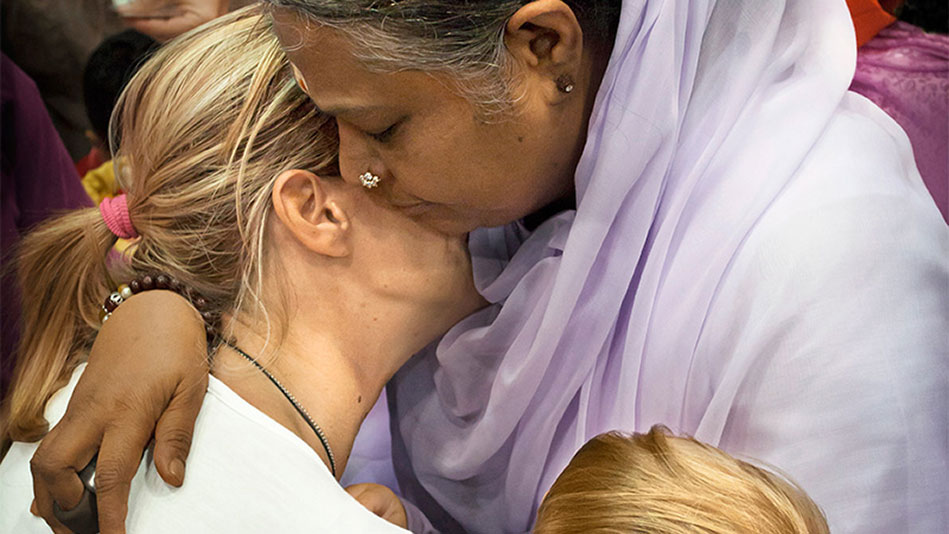
The Dissolution of Self Through Service
Amma's profound assertion, "In serving others, the small self dissolves," invites us to explore the transformative power of selfless service. This statement encapsulates a fundamental truth about the human experience: that our individual identities, often tethered to ego and self-interest, can be transcended through acts of compassion and generosity. The stakes are high; in a world increasingly defined by division and self-centeredness, the path of service offers a way to reconnect with our shared humanity and discover a deeper sense of purpose.
To delve deeper into this teaching, we must recognize that the "small self" refers to the ego, that part of us that clings to separateness and individualism. In contrast, the act of serving others fosters a sense of unity and interconnectedness, allowing us to experience life beyond the confines of our personal desires and fears. This dissolution of the small self is not merely a philosophical concept; it is a lived reality that can lead to profound inner peace and fulfillment. By engaging in service, we not only uplift others but also embark on a journey toward our own spiritual awakening.
The image / the metaphor
The imagery in Amma's quote evokes a powerful sense of transformation. The phrase "small self" conjures the idea of a fragile, isolated entity, while "dissolves" suggests a gentle melting away, akin to ice succumbing to warmth. This metaphor speaks to the natural process of letting go, where the rigid boundaries of the ego soften and ultimately disappear in the face of love and compassion. The verbs chosen here—"serving" and "dissolves"—imply an active engagement with the world and a surrendering of the self, creating a dynamic interplay between action and release.
In the speaker's tradition
Amma's teachings are deeply rooted in the bhakti tradition, which emphasizes devotion and love as pathways to spiritual realization. Central to this tradition is the concept of dharma, or righteous duty, which encourages individuals to act in ways that promote the welfare of others. In this context, service is not merely an act of kindness but a sacred duty that aligns with one's higher purpose. The dissolution of the small self through service resonates with the idea of kenosis, or self-emptying, found in various spiritual traditions, where the relinquishing of ego leads to a fuller experience of divine love.
Moreover, the notion of sunyata, or emptiness, in Buddhist philosophy parallels Amma's teaching. Just as sunyata invites us to recognize the illusory nature of the self, Amma's call to serve others encourages us to see beyond our individual identities. In the Bhagavad Gita, Krishna speaks of selfless action as a means to attain liberation, reinforcing the idea that true freedom arises when we act without attachment to the fruits of our labor. This interconnectedness of service and spiritual awakening is a cornerstone of Amma's philosophy, inviting us to embrace the transformative power of love in our lives.
Living the teaching
Consider a modern scenario where this teaching can be applied: a community struggling with food insecurity. By volunteering at a local food bank, individuals can experience the profound impact of service. As they engage in the act of providing nourishment to those in need, they may find their own worries and concerns dissipating, replaced by a sense of purpose and connection. In this context, the small self begins to dissolve as they recognize their shared humanity with those they serve, fostering a sense of belonging and collective responsibility.
In a different application, think about a challenging relationship, perhaps with a family member or colleague. By approaching the situation with a mindset of service—listening deeply, offering support, and prioritizing the other person's needs—one can begin to transcend personal grievances and ego-driven reactions. This shift in perspective allows for healing and reconciliation, illustrating how the act of serving others can lead to the dissolution of the small self and the emergence of compassion and understanding. In daily practice, even small acts of kindness can serve as reminders of this teaching, inviting us to step beyond ourselves and embrace the interconnectedness of all beings.
A reflection
As we contemplate Amma's profound statement, we are invited to reflect on our own lives and the ways in which we engage with others. How can we cultivate a spirit of service in our daily interactions? In what ways might our small selves be holding us back from experiencing the fullness of connection and love? By pondering these questions, we open ourselves to the possibility of transformation, allowing the light of service to illuminate our paths and guide us toward a deeper understanding of our shared existence.