The Generosity of Love: A Contemplation on Selfless Giving
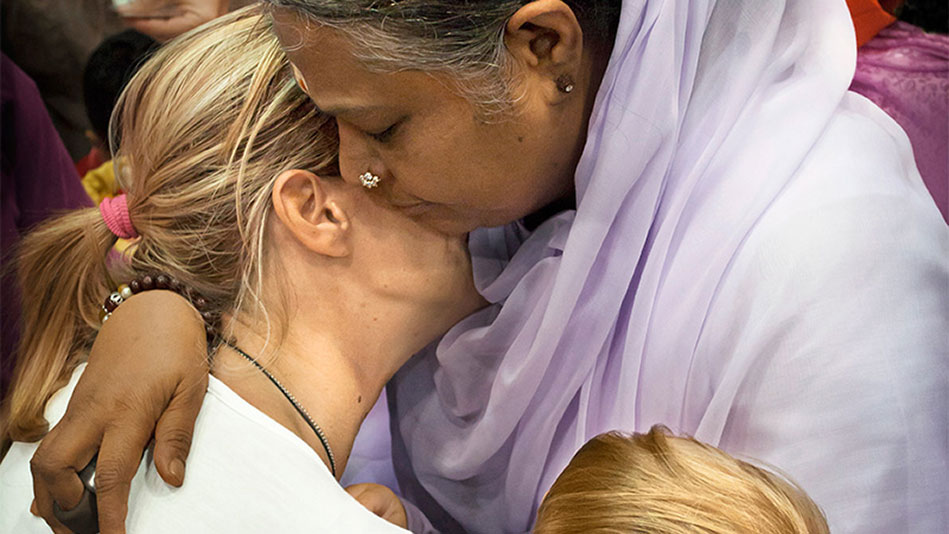
Amma's poignant assertion, "Love does not ask. Love gives," invites us to reflect deeply on the nature of love itself. This statement encapsulates a profound truth about the essence of love as an unconditional force that transcends the boundaries of expectation and reciprocity. In a world often driven by transactional relationships, Amma's words challenge us to reconsider our understanding of love, urging us to embrace a selfless approach that prioritizes giving over receiving. This perspective not only enriches our personal relationships but also fosters a sense of community and interconnectedness.
To delve deeper into this teaching, we must recognize that love, in its purest form, is an act of liberation. It is not confined by the limitations of desire or need; rather, it flows freely, nourishing both the giver and the receiver. In this light, love becomes a transformative force that can heal wounds, bridge divides, and inspire acts of kindness. By embodying the spirit of giving, we align ourselves with a higher purpose, one that resonates with the core of our humanity and the interconnectedness of all beings.
The image / the metaphor
At the heart of Amma's quote lies a vivid imagery that contrasts the act of asking with the act of giving. The verb "ask" implies a sense of neediness or dependency, while "gives" evokes a sense of abundance and generosity. This juxtaposition invites us to envision love as a river that flows effortlessly, nourishing everything in its path without seeking anything in return. The felt sense of this imagery is one of warmth and openness, suggesting that true love is not contingent upon conditions or expectations.
Diving deeper into the metaphor, we can see that love as giving is akin to the sun shining its light upon the earth. The sun does not ask for acknowledgment or gratitude; it simply radiates warmth and sustenance. In this way, love, when expressed through selfless giving, becomes a source of life and vitality. It encourages us to cultivate a mindset where our actions are motivated by compassion and empathy, rather than a desire for recognition or reward. This shift in perspective can lead to profound changes in how we relate to ourselves and others.
In the speaker's tradition
Amma's teachings are deeply rooted in the tradition of bhakti, which emphasizes devotion and love for the divine as a pathway to spiritual realization. Central to this tradition is the concept of selfless service, or "seva," which embodies the essence of giving without expectation. This aligns with the idea of "kenosis," or self-emptying, found in various spiritual traditions, where one relinquishes the ego to allow love to flow freely. In bhakti, love is not merely an emotion but a transformative practice that connects us to the divine and to one another.
Moreover, the notion of "fana," or annihilation of the self in the love of the divine, resonates with Amma's message. When we give love without asking, we transcend our individual desires and merge into a greater whole. This is beautifully illustrated in texts such as the "Bhagavad Gita," where the concept of "nishkama karma," or selfless action, is emphasized. Here, the act of giving becomes a sacred duty, a way to express our devotion and connect with the divine essence that permeates all existence.
Living the teaching
Consider a modern scenario where this teaching can be applied: a community volunteer program. In such a setting, individuals come together to offer their time and resources to help those in need, often without any expectation of reward. This act of giving fosters a sense of belonging and purpose, illustrating how love manifests in tangible ways. By participating in such initiatives, we not only contribute to the well-being of others but also experience the joy that arises from selfless giving, reinforcing the interconnectedness of our shared humanity.
Another application of Amma's teaching can be found in personal relationships. Imagine a moment of conflict with a loved one, where the instinct may be to seek validation or an apology. Instead, embracing the spirit of love that gives allows us to approach the situation with compassion and understanding. By prioritizing the well-being of the other person and offering forgiveness or support, we create space for healing and connection. This practice of selfless love can transform our interactions, leading to deeper bonds and a more harmonious existence.
A reflection
As we contemplate Amma's profound words, we are invited to reflect on our own relationship with love and giving. How often do we find ourselves in situations where we hold back our love, waiting for something in return? In what ways can we cultivate a practice of giving that is free from expectation? By engaging with these questions, we can begin to embody the essence of love that Amma so beautifully articulates, allowing it to guide our actions and transform our lives.