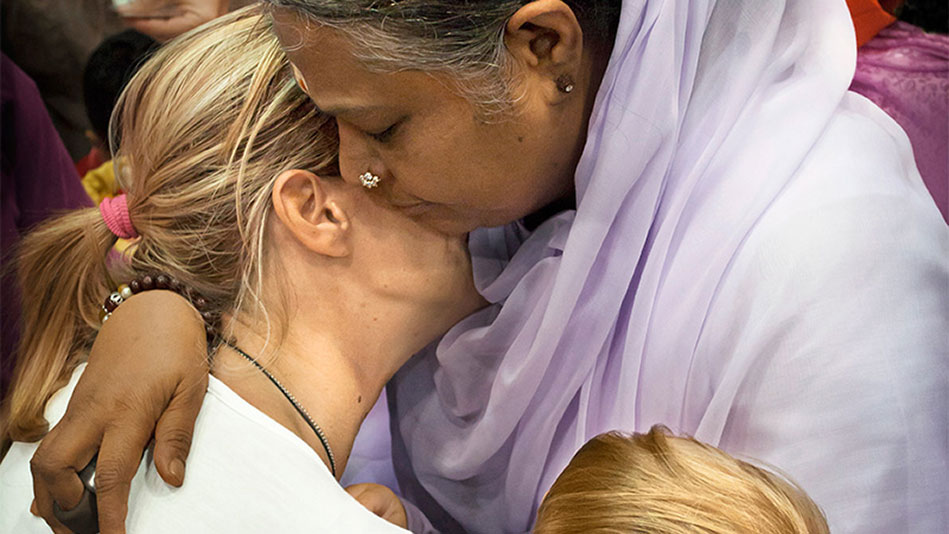
Amma's assertion that "Love is the only true currency" invites us to reconsider our understanding of value in a world often dominated by material wealth and transactional relationships. In this profound statement, she suggests that love transcends the superficial exchanges of society, offering a deeper, more enduring form of wealth that nourishes the spirit. This perspective challenges us to reflect on what we truly value and how we measure richness in our lives, urging us to cultivate love as our primary currency.
In a culture that frequently equates success with financial gain and status, Amma's words resonate as a gentle reminder of the intrinsic worth of love. This teaching encourages us to shift our focus from external validations to the internal richness that love provides. By embracing love as our guiding principle, we can foster connections that are authentic and meaningful, ultimately enriching our lives and the lives of those around us.
The image / the metaphor
The metaphor of love as currency evokes a vivid image of exchange, suggesting that love holds a value akin to money in our interactions. Just as currency can facilitate transactions and create connections, love serves as the foundation for genuine relationships and community. The choice of the word "true" emphasizes that while other forms of currency may hold temporary power, love is the only enduring wealth that can truly enrich our lives and the lives of others.
Diving deeper into this metaphor, we can see that love, unlike material wealth, is not diminished by sharing; rather, it multiplies. When we give love freely, it circulates and returns to us in unexpected ways, creating a cycle of abundance. This understanding invites us to engage in acts of kindness and compassion, reinforcing the idea that love is a renewable resource, one that grows stronger the more we invest in it.
In the speaker's tradition
Amma's teachings are deeply rooted in the bhakti tradition, which emphasizes devotion and love for the divine as the highest form of spiritual practice. In this context, love is not merely an emotion but a transformative force that connects us to the divine and to one another. Concepts such as dharma, or righteous duty, and kenosis, the self-emptying love exemplified by spiritual figures, align with Amma's assertion that love is the ultimate currency, guiding our actions and intentions in the world.
In the Bhagavad Gita, we find a parallel sentiment in the idea that selfless action, driven by love and devotion, leads to liberation. The text teaches that when we act out of love rather than attachment to outcomes, we align ourselves with a higher purpose. This connection between love and spiritual fulfillment underscores the importance of viewing love as a currency that enriches not only our lives but also the lives of those we touch.
Living the teaching
Consider a modern scenario where this teaching might manifest: a workplace environment where competition often overshadows collaboration. In such a setting, individuals may prioritize personal gain over collective well-being, leading to a toxic atmosphere. However, when one person chooses to lead with love—offering support, encouragement, and understanding—the dynamics can shift. This act of prioritizing love as a currency can foster a sense of community, transforming the workplace into a space where everyone thrives.
In personal relationships, the application of Amma's teaching can be equally profound. Imagine a moment of conflict with a loved one, where misunderstandings and hurt feelings create distance. By consciously choosing to respond with love—listening deeply, expressing empathy, and seeking to understand rather than to be understood—we can bridge the gap. This practice of prioritizing love over ego not only resolves the immediate conflict but also strengthens the bond, reinforcing the idea that love is indeed the only true currency in our lives.
A reflection
As we contemplate Amma's assertion that "Love is the only true currency," we are invited to examine our own lives and relationships. What forms of currency do we prioritize in our daily interactions? Are we investing in love, or are we caught in the cycle of material gain and superficial exchanges? Reflecting on these questions can lead us to a deeper understanding of our values and the ways in which we can cultivate love as our guiding principle.