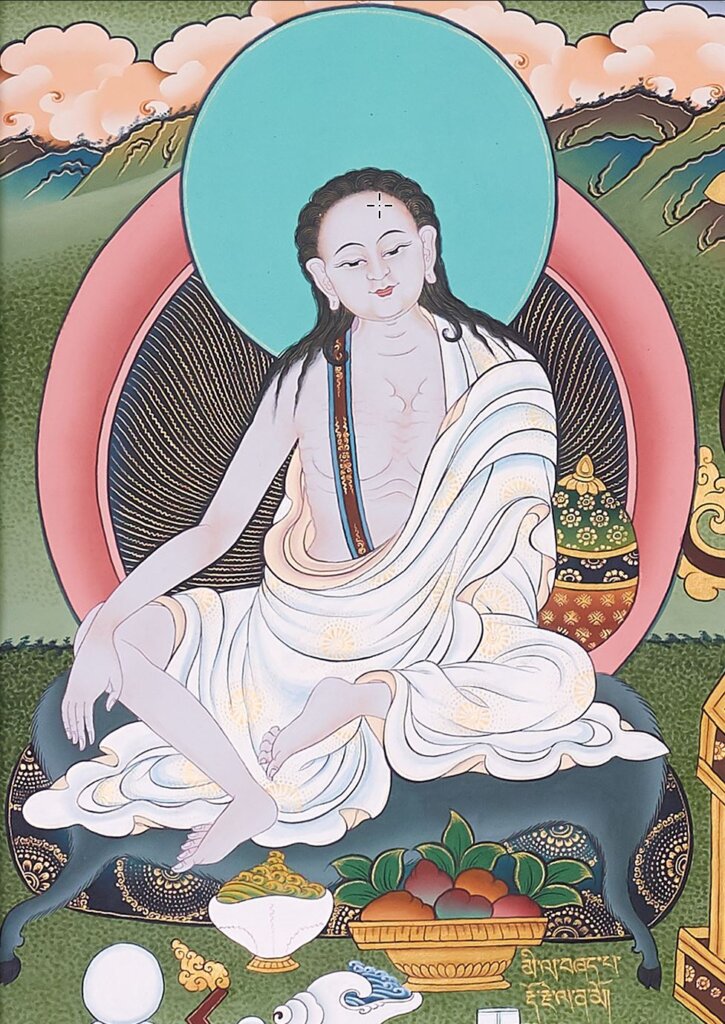
Milarepa's profound assertion, "The cave's quiet is the temple of the heart," invites us to explore the relationship between silence and the inner sanctum of our being. In this statement, the cave symbolizes a space of stillness, a refuge where one can retreat from the clamor of the external world. The heart, often regarded as the seat of our deepest emotions and spiritual truths, finds its sanctuary in this quietude. This teaching matters profoundly in our fast-paced lives, where distractions abound and the noise of daily existence often drowns out our inner voice.
Delving deeper, we recognize that the cave is not merely a physical space but a metaphor for the inner landscape of our consciousness. It suggests that within each of us lies a sacred space, a temple that thrives in silence. This quietude is not an absence but a presence—a fertile ground for introspection, healing, and spiritual awakening. In a world that often equates busyness with productivity, Milarepa's words remind us of the transformative power of stillness and the importance of nurturing our inner temple.
The image / the metaphor
The imagery of a cave evokes a sense of solitude and refuge, a place where one can escape the incessant noise of the outside world. The choice of the word "quiet" emphasizes a profound stillness, suggesting that true peace is found not in the absence of sound but in the depth of silence. This quiet is not merely a backdrop; it is an active space where the heart can resonate with its own truths. The cave, as a metaphor, invites us to consider our own inner landscapes and the ways in which we cultivate or neglect them.
In the speaker's tradition
Milarepa, a revered figure in Tibetan Buddhism, embodies the principles of dharma and the transformative power of meditation. His life story is a testament to the journey from suffering to enlightenment, emphasizing the importance of inner silence as a means to attain spiritual clarity. Concepts such as sunyata, or emptiness, resonate deeply with Milarepa's teaching, suggesting that in the quiet of the cave, one can encounter the vastness of existence beyond the distractions of the ego. This inner emptiness is not a void but a space filled with potential, where the heart can awaken to its true nature.
In the context of Milarepa's teachings, we can draw parallels to the practice of meditation found in various Buddhist texts. For instance, the "Heart Sutra" speaks of the interdependence of form and emptiness, echoing the idea that the quiet of the cave allows us to transcend dualistic thinking. Just as the cave serves as a refuge, meditation becomes a practice that cultivates the heart's capacity for compassion and wisdom. In this way, Milarepa's quote encapsulates the essence of a spiritual journey that seeks to harmonize the inner and outer worlds.
Living the teaching
Consider a modern scenario where the teaching of Milarepa resonates: a busy professional overwhelmed by the demands of work and life. In this context, the cave's quiet becomes a metaphor for the moments of stillness one can carve out amidst the chaos. Perhaps it is a few minutes of mindful breathing during a hectic day or a dedicated time for reflection in the early morning. These moments of quiet serve as a reminder that even in the busiest of lives, we can find our inner temple, a space where clarity and peace reside.
Another application of this teaching might arise in the realm of relationships. Imagine a conflict with a loved one, where emotions run high and communication falters. In such moments, the cave's quiet can serve as a guiding principle, encouraging us to step back and create a space for reflection before reacting. By embracing silence, we allow ourselves to process our feelings and approach the situation with a heart that is open and receptive. This practice of cultivating quietude can transform our interactions, fostering deeper understanding and connection.
A reflection
As we contemplate Milarepa's profound words, we are invited to reflect on the nature of our own inner caves. What does the quiet of your heart reveal to you? In a world that often prioritizes noise and distraction, how can you create sacred spaces of stillness in your life? This contemplation encourages us to explore the depths of our being, inviting us to listen to the whispers of our heart and to honor the temple that resides within.
