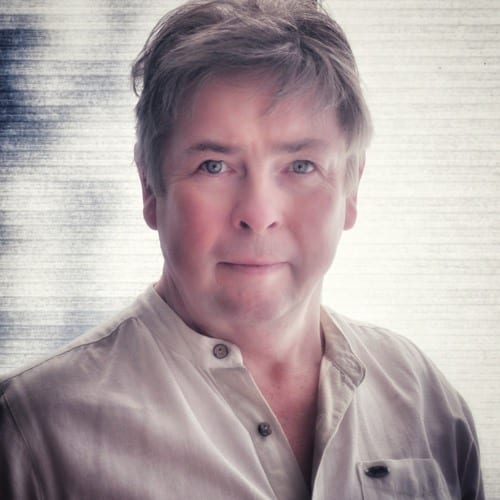
Tom Evans describes himself as a meditation guide, mystic engineer, storyteller and contemporary alchemist. Those labels matter because they describe a teacher who does not sit comfortably in any single category. He is an author, a composer and a speaker, and he treats these as parts of one practice rather than separate careers. The question for anyone approaching his work is whether that synthesis produces rigour or merely range. The evidence suggests an honest answer is "both, depending on the listener."
Evans's teaching is organised less around a retreat model than around recorded, modular and short-form material. His guided meditations on living well through a short daily meditation are built for ordinary schedules, not monastic intensity. His largest project, the Path to Overstanding, runs to roughly 100 audio modules, including 22 meditations keyed to the Major Arcana and 22 ambient tracks inspired by them. It is designed to be taken in sequence. He has also built self-study courses, including Living Timefully, and has taught live guided meditations.
The public record does not describe a typical in-person retreat, and no tour or retreat dates are visible. A session with Evans is best understood from what he has published: a guided visualisation, usually with composed sound, offered as an experience to be undergone rather than a doctrine to be absorbed. His ambient albums, including Stygian (2022) and Origins (2025), are framed as guided perceptual experiences, not background listening. That distinction tells you how he expects you to show up: attentive, not passive.
The first theme is awakening nascent potential. Evans's stated aim is to help people awaken latent aspects of their consciousness and enhance their creativity, and to welcome transformation with calm, clarity and fun. This is a different promise from stress relief or the resolution of suffering. It is closer to capacity-building.
The second is time. His bio says he researched ideas about time empirically and looked for ways to put them to practical use, and Living Timefully carries that interest into a course.
The third is the pairing of imagination and technology. He does not present technology as an obstacle to inner work, and he writes about how it might serve awakening.
The fourth is the Major Arcana as architecture. The 22 keys serve as waypoints for meditation, not as tools for fortune-telling.
Finally, there is Soulwave, his channelled post-dystopian cyberpunk novel, which he worked on for many years. Its premise, a universe built on waves of consciousness energy, gives his teaching a cosmology, and it is the clearest place to see it stated.
Evans's materials point toward certain questions, though the record offers no verbatim prompts, so these are inferences from the work's structure. What in you has not yet been used? What changes if you treat time as something to investigate rather than merely endure? What happens when imagination is treated as a working instrument, not a distraction from "real" practice? And can a brief daily practice, kept up, change how you function across a whole life? The emphasis is on experiment: try the practice, observe, decide.
The delivery is story-led and sound-led. Evans is a novelist first in many respects, and he brings narrative and visualisation into meditation. Composed ambient music is part of the method. Where silence appears, it is probably the silence inside a guided piece rather than a vow of quiet. The tone is deliberately unsentimental. Those who have worked with him praise how simply and naturally he explains complex ideas, bridging meditation, creativity and consciousness. His engineering training shows in that clarity, and in a preference for testing ideas over asking for belief.
Humor is part of the stated intent, since "fun" sits beside calm and clarity in his own description, though the sources do not show how it sounds in practice. Scripture does not feature as a source; his symbolic material comes from the Tarot's Major Arcana.
It lands for readers of science fiction, people curious about consciousness and philosophy, and those who want meditation that engages the intellect instead of asking it to step aside. It suits people comfortable with ambiguity and willing to treat a practice as an exploration.
It will likely frustrate several groups. Beginners wanting one coherent system with step-by-step instruction will find a syncretic, experimental body of work with no single method to master. Those seeking plain relaxation may find the aims too large. Seekers who believe authentic practice must be offline and analogue will find his embrace of technology incompatible with theirs. Readers who prefer ancient authority or a clear teacher-student hierarchy will find none here. And the cosmology, with its soulwaves and channelled fiction, asks for a tolerance of speculation that some will not share. The unsparing view is that the framework is imaginative rather than demonstrated.
Evans's bio names no teacher, guru or lineage, and it would be wrong to assign one. What it does state is his trade and temperament: he trained as an engineer and brings that curiosity to spiritual subjects. His own account is that the Universe turned him into an unexpected meditation guide while he was publishing books. His material draws on Tarot imagery, alchemical language and speculative fiction, and he curates The Adytum, described as a contemporary school of practical alchemy. He is best read as a self-described contemporary alchemist working outside any declared lineage, which is both his freedom and the limit of what can be claimed for his authority.
The most structured entry is the Path to Overstanding. A lighter one is his YouTube channel (@TomEvans), with shorter guided meditations. Readers who prefer narrative can start with Soulwave; This We Know, written in 14 days in 2012, is the other key book. Eighteen books were published by 2023. Sample one meditation and one album track before committing. That is also how he seems to want to be judged: by what the practice does for you.