Service as the Heartbeat of Meditation
Amma's profound assertion that "Service is meditation in action" invites us to reconsider the relationship between inner contemplation and outward expression. In a world often divided between the sacred and the mundane, this quote serves as a bridge, suggesting that true meditation transcends mere stillness and manifests in our interactions with others. The stakes are high: understanding this connection can transform our daily lives, allowing us to infuse our actions with the same depth and intention we cultivate in our quiet moments of reflection.
To deepen our understanding, we must recognize that service, in this context, is not merely a duty or obligation but a sacred practice that embodies the essence of meditation. It calls us to engage with the world around us, to see our actions as extensions of our inner spiritual journey. This perspective challenges the notion that meditation is confined to solitary practice, revealing instead that the heart of spirituality beats in the rhythm of compassionate action.
The image / the metaphor
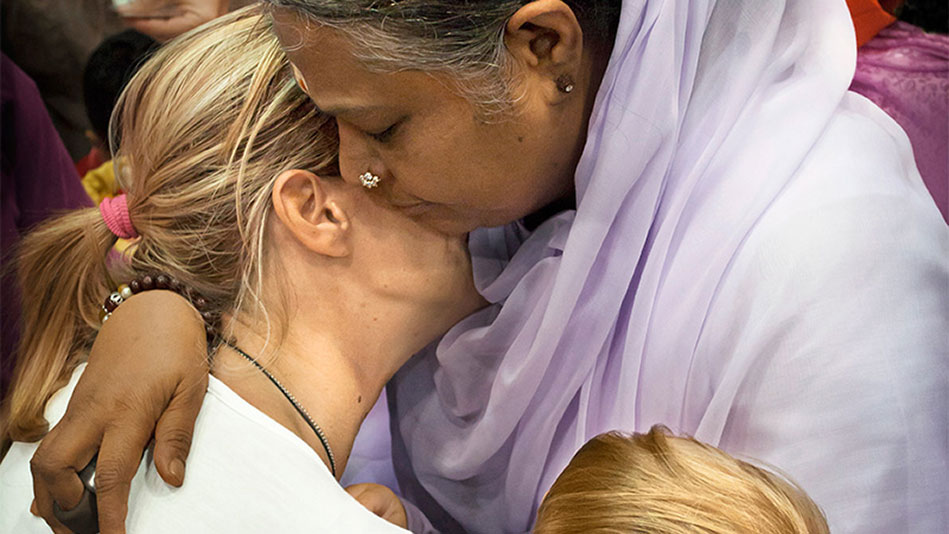
The imagery in Amma's quote evokes a dynamic interplay between stillness and movement. The word "service" conjures images of hands reaching out, hearts opening, and lives being touched, while "meditation" suggests a deep, internal stillness. The verb "is" serves as a powerful connector, indicating that these two states are not separate but rather two sides of the same coin. This synthesis invites us to feel the pulse of life in both our quiet moments and our active engagements.
In the speaker's tradition
Amma's teachings are deeply rooted in the bhakti tradition, which emphasizes love and devotion as pathways to the divine. In this context, service is not just an act of charity; it is an expression of bhakti, a way to honor the interconnectedness of all beings. Concepts such as dharma, or righteous duty, and kenosis, the self-emptying love exemplified by the divine, resonate here, suggesting that true service arises from a place of surrender and love.
In the Bhagavad Gita, we find a parallel in the idea of selfless action, or karma yoga, which teaches that performing one's duty without attachment to the fruits of the action leads to spiritual liberation. This aligns beautifully with Amma's assertion, as both perspectives highlight the importance of intention and devotion in our actions. By embracing service as a form of meditation, we align ourselves with the teachings of the Gita, recognizing that our every action can be a step toward spiritual awakening.
Living the teaching
Consider a modern scenario where this teaching can take root: imagine a busy office environment where colleagues often rush past one another, absorbed in their tasks. In such a setting, one might choose to pause and offer a listening ear to a co-worker who seems overwhelmed. This simple act of service, performed with mindfulness, transforms the moment into a meditative practice, fostering connection and compassion amidst the hustle and bustle of daily life.
Another application of this teaching can be found in our personal relationships. During a disagreement with a loved one, instead of reacting defensively, we might choose to approach the situation with a spirit of service—listening deeply, seeking to understand their perspective, and responding with kindness. In this way, we embody the essence of meditation in action, allowing our relationships to flourish through the practice of love and compassion.
A reflection
As we contemplate Amma's words, we are invited to reflect on the ways in which our actions can become expressions of our inner spiritual lives. How can we transform our daily tasks into acts of meditation? In what ways can we serve others with the same depth of presence we cultivate in our moments of quiet reflection? This inquiry invites us to explore the profound interconnectedness of our inner and outer worlds, reminding us that every act of service can be a step toward greater awareness and compassion.