There's a moment in deep listening when the boundary between sound and silence dissolves. You're breathing slowly, and so is the music—in, out, suspended. This is the space that Silvia Nakkach's album Liminal inhabits. Not background music. Not the trance state of club culture. Not the directive intensity of classical narrative. Something else: an ambient-sound journey designed to become, in the artist's own words, "the place when one can go when needed more space."
Liminal arrives as what might be called a sonic threshold. The term "liminal" describes the in-between, the space of transition—not quite one state, not yet another. Doorways. Dawn. The moment between sleep and waking. Anthropologists call it the liminal phase. What Nakkach has done is translate that threshold into sound: music that exists not to tell you where to go, but to hold you gently in the possibility of going anywhere at all.
Nakkach, a Grammy-nominated artist, has spent her career understanding how voice and intention shape listening space. Liminal, released in 2016, represents a particularly intentional experiment in unbounded sound. The album draws inspiration from clouds—that most liminal of natural phenomena, neither solid nor liquid, forever shifting, defining no fixed boundary. In the hands of Nakkach and her collaborators, this becomes both metaphor and method.
The concept of liminal space has deep roots. In ritual theory, the liminal phase is where transformation happens—the threshold where the old self is stripped away before a new identity is assumed. It's considered sacred precisely because it's undefined. In architecture and psychology, liminal spaces (empty airports, hotel hallways, parking garages) evoke an eerie, almost supernatural quality. They're not meant to be lived in; they're meant to be passed through. Yet there's something compelling about them, something that invites introspection.
Nakkach's Liminal asks: what if a liminal space became a place to live in, at least for the duration of listening? What if the threshold itself became the destination? This inverts the typical purpose of such spaces. Instead of a hallway to somewhere else, the music becomes the somewhere. The transition is the point.
This is particularly significant for contemplative practice. Meditation isn't about reaching an altered state and staying there. It's about developing a capacity to move fluidly between states—alert attention, relaxation, insight, peace. A mind stuck in any single state isn't free. Liminal creates an acoustic environment that mirrors and supports this fluid movement. It's music for practitioners.
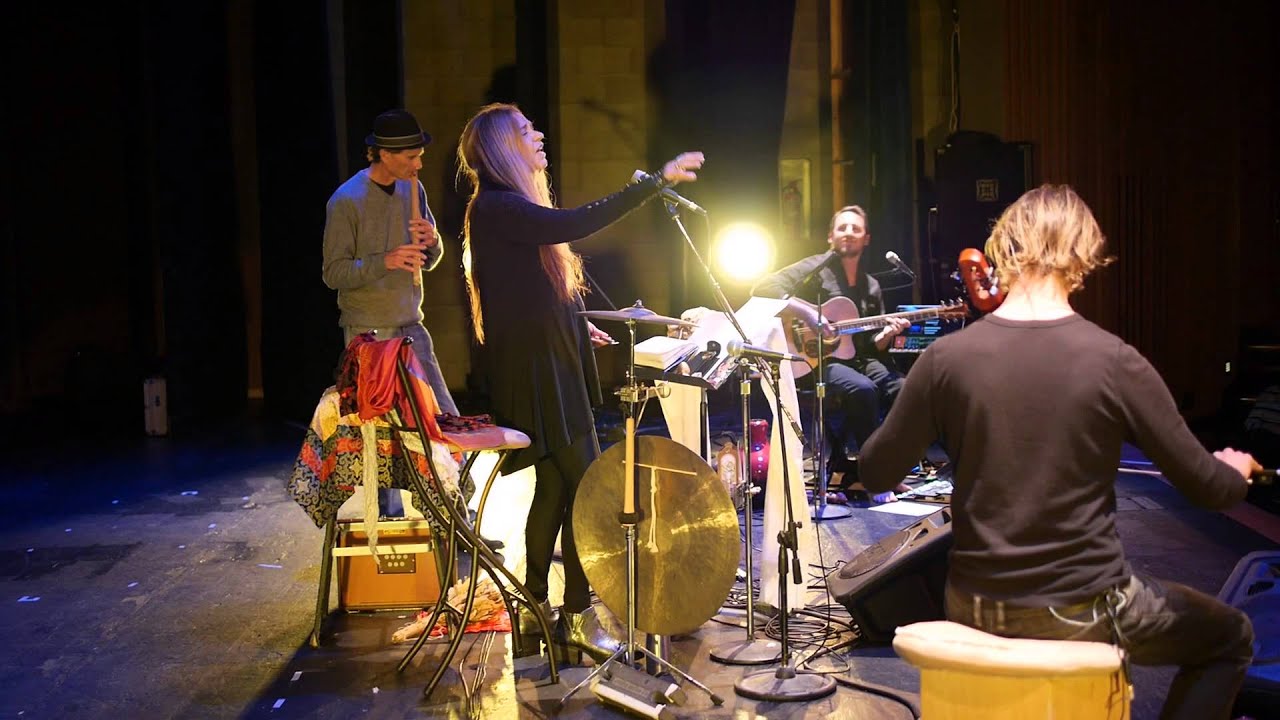
The instrumentation is deceptively simple: Nakkach herself on vocals, piano, and sound design; Todd Boston on guitar, piano, keyboards, guitarviol, and sound design; Jeff Oster contributing flugelhorn and trumpet. On paper, these are instruments loaded with tradition and voice. Piano carries centuries of classical weight. Trumpet has announcement and virtuosity baked into its DNA. But on Liminal, each instrument is used not for what it typically says, but for what it can become—sound stripped of narrative demand, oriented instead toward space-making.
Piano here isn't a vehicle for melody or emotion in the dramatic sense. It's closer to drone, to sustain. The piano becomes an extension of silence, a way of making silence visible in sound. Traditional music uses silence as negative space—the gaps between notes. On Liminal, silence and sound are nearly equal in presence. The piano doesn't fill space; it defines it.
Voice doesn't declaim or perform; it becomes texture, part of the ambient fabric. In Western music tradition, the human voice is the most expressive instrument, the seat of emotion and personality. Yet on Liminal, Nakkach's voice functions more like an instrument of nature—a wind passing through, a resonance, a presence that's human but not personal. You're never aware of the singer performing; you're only aware of sound, existing.
The flugelhorn, softer than its brighter cousin the trumpet, enters the soundscape less as a voice than as a presence. Traditional trumpet playing is about cutting through, being heard, making a statement. The flugelhorn's mellower timbre allows it to breathe with the other elements rather than dominate them. Guitar appears not in chords and progressions, but in subtle sound design—texture that occupies frequency space. These are musicians trained in their instruments' traditional vocabularies, now using that mastery to create something that conventional music theory doesn't quite address.
This is crucial: Liminal is not "easy listening" in the dismissive sense. It's not music designed to be ignored. It's music that asks for active listening—not in the way a demanding jazz solo does, but in a gentler way. To listen to Liminal is to participate in its creation of space. Your attention, your breathing, your openness become part of the composition. The artist's statement—"This music is like breathing in and out slowly… Listening becomes the place when one can go when needed more space"—isn't poetic exaggeration. It's a precise description of what the music does.
How does music create space? Traditional classical music creates psychological space through narrative and contrast. A sonata moves from tension to resolution. A symphony builds and releases. These architectures create internal movement in the listener. But Liminal works differently. It doesn't move toward anything. It simply expands. The space isn't created through drama; it's created through the quality of the sound itself—the way each instrument occupies its frequency range, the way silence is integral to every moment, the way nothing is rushing.
There's a technical component to this. On a purely acoustic level, music designed for space-making uses specific techniques: long sustains that allow ears to relax into the sound, minimal harmonic movement that doesn't create expectation, dynamics that are gentle rather than dramatic. Each of these is present on Liminal. But technique alone doesn't make contemplative music. Plenty of new-age albums use these techniques while remaining shallow, using the language of spaciousness without the substance. What distinguishes Liminal is intentionality paired with restraint. Nothing is wasted. Nothing is added for decoration.
The label "ambient" often carries baggage. Since Brian Eno codified the term in the late 1970s with albums designed to be "actively listened to, at the same time as one does other things," ambient music has been stretched thin—used to describe everything from Starbucks soundtracks to new-age cliché to genuine experiments in how music can exist in psychological space. Liminal belongs to the latter category. It's ambient not because it's inoffensive, but because it creates environment. You don't listen to it the way you listen to a song. You enter it. You move through it. If you're receptive, it moves through you.
The cloud inspiration matters here. Clouds are never still, never the same, yet always recognizable as clouds. They offer visual space without definition. Nakkach has translated this into a sonic principle: music that holds form lightly, that suggests without declaring, that invites without demanding. Each listening can be different. There's no "correct" way to experience Liminal. The album becomes a space, and you become whatever you need to be in that moment.
The collaboration between Nakkach, Boston, and Oster is worth noting. This isn't a solo artist working in isolation. It's musicians trained in precision and form choosing to create formlessness together. Todd Boston, who produced the album, brought both technical expertise and shared vision. The guitarviol—a hybrid instrument Boston plays—is itself a liminal instrument, existing between guitar and viol traditions. The choice to include it is telling: Nakkach assembled a team capable of playing at the threshold, musicians comfortable in undefined space.
The result isn't chaos or accident—it's carefully constructed spaciousness. Every element is there by design. Nothing is accidental. Yet nothing announces itself as important. This is the paradox at the heart of contemplative sound design: total intentionality in service of openness. It's like a Zen garden—every stone placed with precision, yet the effect is one of effortless nature.
The album was released during a moment when interest in mindfulness, meditation, and sonic wellness was growing across Western culture. Yet Liminal doesn't market itself as a tool for productivity or sleep. It doesn't promise outcomes. It simply offers what it offers: a place to go when you need more space. That's radical restraint in an era of algorithmic optimization and quantified self-improvement. The music asks nothing of you except presence.
For listeners drawn to intentional soundscapes—whether practitioners of meditation, people seeking refuge from overstimulation, musicians interested in experimental approaches, or simply people who crave beauty in threshold spaces—Liminal functions as both sanctuary and catalyst. It creates the conditions for your own inner work without prescribing what that work should be. In this way, it honors both the artist's intention and the listener's autonomy. The space between is where the music actually lives.
Liminal is available across platforms—iTunes, CDBaby, Amazon, and Bandcamp—for listeners ready to enter its threshold space. The album invites a particular kind of listening: uninterrupted, open, without expectation. Best experienced with quality audio and undivided attention, though it works equally well as ambient accompaniment to introspective time.
For those drawn to this work, exploring other contemplative composers working in ambient and experimental music offers rich territory. The key is looking for intentionality—artists who use silence as actively as sound, who resist the temptation to fill space, who create conditions rather than destinations. Liminal stands as an example of music-making at service to the listener's own inner space, a collaboration between artist and listener in creating the sacred threshold between worlds.