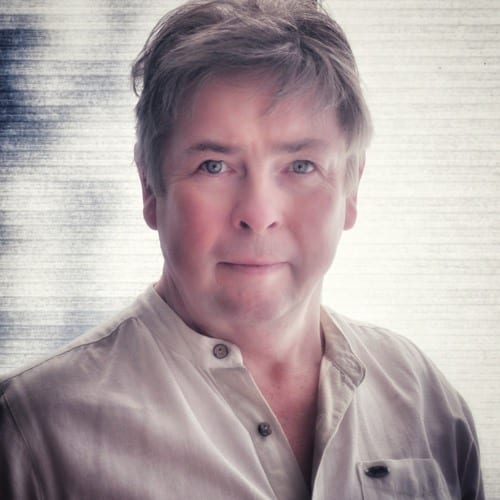
Tom Evans describes himself as a meditation guide, mystic engineer and storyteller, and as a contemporary alchemist. He trained as an engineer, and he brings that curiosity to spiritual subjects. By 2023 he had published 18 books, and his work spans guided meditation, ambient music, fiction and a large audio curriculum. That breadth can make the entry point unclear. This guide picks one and sequences the rest.
Start with Origins, his album released in August 2025. It has 15 tracks and is his most recent work as a composer. His own sources describe his albums as guided perceptual experiences rather than background listening, so treat it that way: headphones, no multitasking, one sitting if you can manage it. It costs you nothing but time on Spotify, and it tells you quickly whether his sensibility suits you before you commit to anything larger.
His YouTube channel (@TomEvans). This is the lower-friction route into his spoken guidance. Look for the shorter guided meditations on living weller through daily "me time" practice. They are built for modern life, not monastic intensity.
Soulwave. This is his channelled novel, which he describes as post-dystopian cyberpunk and worked on for many years. It is the way in if you take in ideas best through story. The book's premise, a universe built on soulwaves, meaning waves of consciousness energy, is the metaphysical frame behind much of his thinking, delivered through narrative instead of lecture.
The Path to Overstanding. This is the major project: roughly 100 audio modules, including 22 meditations keyed to the Major Arcana and 22 ambient compositions. It is designed to be taken in sequence, not sampled at random. Come to it after you know you like his voice.
If you want a shorter book, This We Know is the other one to know. He wrote it in 14 days in 2012. His sources don't detail its structure, so approach it with open expectations.
Expect a tone of calm, clarity and fun, and not the soft-focus language common to meditation apps. He treats you as someone with both a mind and an imagination. His work blends meditation, music, storytelling and technology instead of separating them into tracks. He writes about the role AI and technology might play in awakening, which is unusual in this field.
The music is meant for active listening. Expect composed textures designed as doors to perception, not wallpaper.
Expecting a relaxation product. He does offer practical daily guidance, but his stated aim is awakening nascent human potential and enhancing creativity, not simple stress relief.
Expecting a single system. He names no lineage to a particular teacher or Eastern tradition. His approach is syncretic, drawing on Western esoteric sources such as alchemy and the Major Arcana, and his school, The Adytum, is described as a contemporary school of practical alchemy. It is an exploration, not fixed doctrine.
Treating the Major Arcana as fortune-telling. In his curriculum the cards serve as archetypal waypoints for consciousness exploration, not tools of divination.
Assuming technology is the enemy of practice. For him it is a potential collaborator. If you believe real inner work must be offline and analog, this will clash with your view.
Skipping the fiction. Soulwave is not a side project. It carries his metaphysics in story form.
It tends to land hardest for people who read science fiction, enjoy philosophy and consciousness research, and want a practice that engages thinking instead of asking them to escape it. It also suits those who have outgrown generic wellness language but still want a daily practice. If you are drawn to Tarot as a symbolic language, or you are curious about creativity and imagination as trainable capacities, the timing is good. If you are in acute need of a simple, containable method with step-by-step instruction, you may find the breadth scattered, and a more conventional teacher may serve you better first.
Day 1: Listen to Origins straight through with headphones and no distractions. Note which tracks hold your attention.
Day 2: Watch one short guided meditation on his YouTube channel about daily me time. Do it as instructed.
Day 3: Repeat a YouTube meditation, or choose a different one, and notice whether his voice and pacing suit you.
Day 4: Read the opening chapters of Soulwave. Pay attention to how the idea of soulwaves is introduced through the story.
Day 5: Return to Origins, this time using your favorite tracks as a meditation soundtrack with your eyes closed.
Day 6: Do one more YouTube meditation, then read a little more Soulwave.
Day 7: Review. Which format held you best: music, spoken meditation or fiction? If the answer is clear and you want structure, begin the Path to Overstanding from its first module and commit to taking it in order. If not, keep going with the format that worked and revisit the rest later. Check tomevans.co for courses and the full list of books.