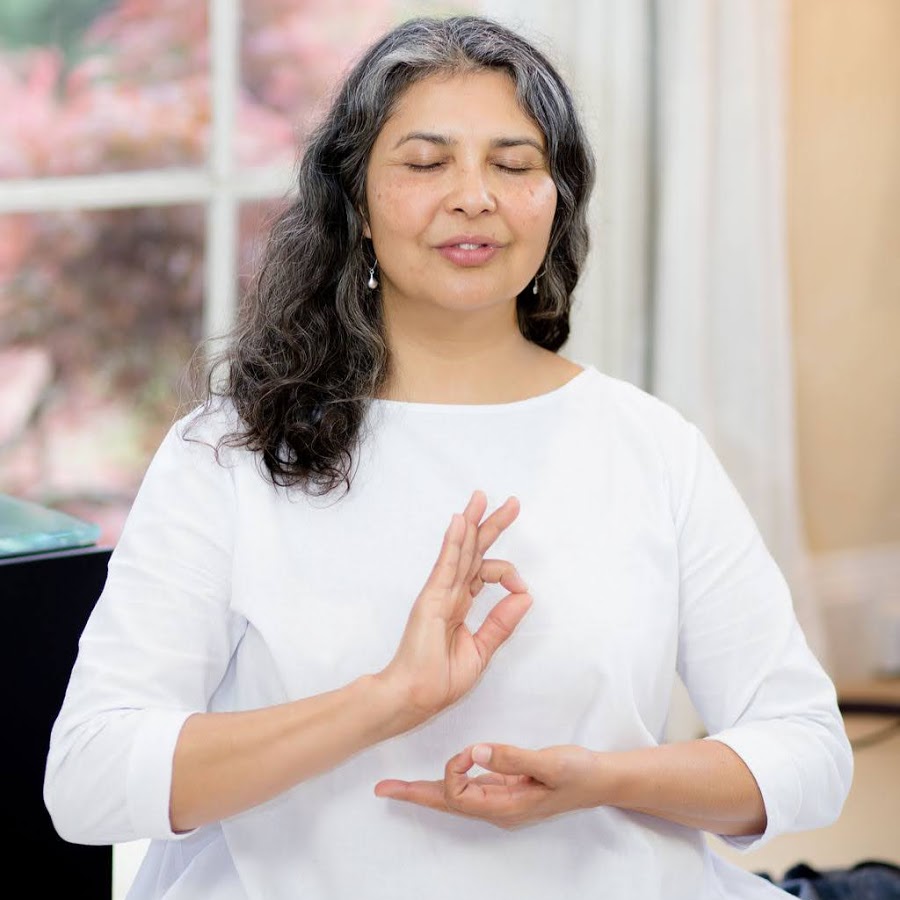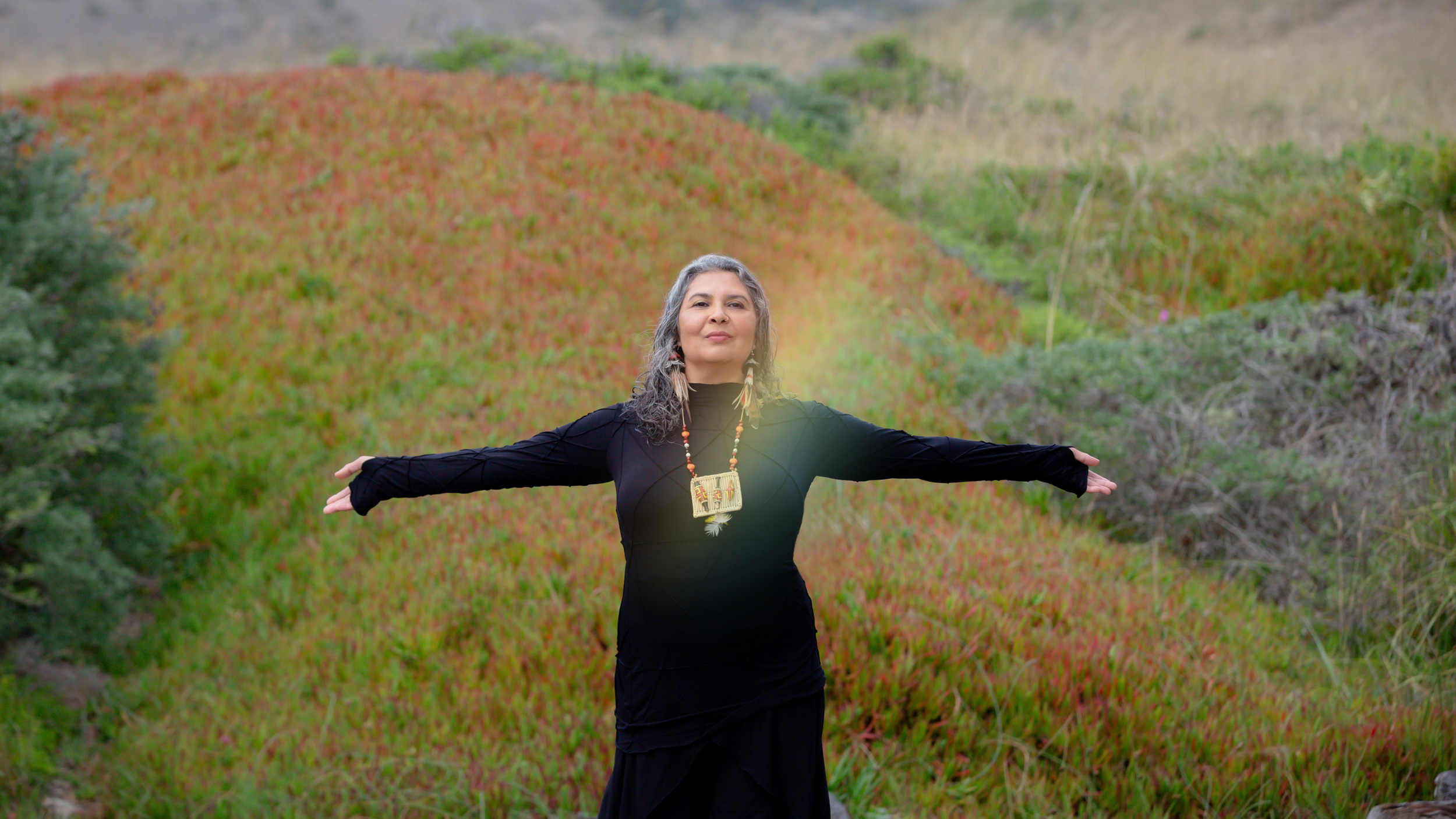

A session with Nubia Teixeira does not begin with sun salutations. It begins with gesture. Hands folded at the heart, fingers articulated into precise configurations—anjali mudra, perhaps, or abhaya, the gesture of fearlessness. The room is likely warm, not from heated floors but from candles, perhaps an altar draped in silk. There may be images of Lakshmi, Saraswati, Durga. The class moves slowly, sometimes glacially, through sequences that prioritize symbolic hand positions and breath regulation over athletic flow. Mantras are chanted, not as ambient soundtrack but as structural anchors. Students hold shapes longer than feels natural in contemporary vinyasa culture. The emphasis is not on what the body can do, but on what it can invoke.
Her retreats extend this aesthetic into days. Odissi dance vocabularies infiltrate asana practice—tribhangi, the classical three-bend posture, becomes a standing meditation. Pranayama sessions may last thirty minutes. There is mythology, stories of goddesses told not as inspirational metaphor but as theological instruction. Teixeira is training practitioners to see their physical practice as inseparable from devotional ritual, their bodies as instruments of bhakti.
Teixeira returns, again and again, to the intelligence of gesture. Where much Western yoga teaching treats mudras as decorative add-ons or vague energetic suggestions, she insists they are precise technologies. Each finger corresponds to an element, each configuration channels prana in specific ways, each hand position carries iconographic weight from centuries of temple practice. She asks students to slow down enough to feel the difference between chin mudra and jnana mudra, to notice what shifts when the hands change even as the body stays still.
The Divine Feminine is not incidental to her teaching but foundational. She works within Hindu goddess traditions, teaching that Shakti—divine creative power—is accessed through embodied practice. This is not the sanitized, universalized "divine feminine" of Western spiritual marketing, but a specific engagement with Lakshmi's abundance, Saraswati's discernment, Kali's destruction, Durga's protection. Students are asked to study iconography, learn the attributes of different goddess forms, understand the theology they're moving through.
She also persistently addresses what she sees as the masculine bias in how yoga has been transmitted to the West—the emphasis on strength, achievement, linearity, the guru-as-patriarch model. Her pedagogy offers an alternative: circular, receptive, collaborative, rooted in devotion rather than conquest.
Teixeira does not traffic in productivity or optimization. The questions she pushes students to sit with are older and slower: What does your body know that your mind refuses? What changes when you treat movement as prayer? Can you sustain devotion without certainty? She asks practitioners to examine their relationship to power—why they practice, what they're hoping to control, whether they can surrender without collapsing.
For students trained in alignment-obsessed or fitness-forward yoga, she poses an unsettling question: What if precision of gesture matters more than depth of stretch? What if beauty and devotion are themselves valid aims, not superficial distractions from "real" practice?
Teixeira teaches through demonstration, story, and silence. Her own body, trained in Odissi for decades, becomes the primary text. She moves with the articulation of a classical dancer—every angle of the wrist deliberate, every shift of weight meaningful. There is ritual formality to her delivery, a sense that the teaching is being transmitted, not invented.
She uses mythology extensively, narrating episodes from the goddess traditions with the assumption that students will meet these stories as scripture, not entertainment. Humor is not absent, but it is not the primary binding agent. What holds the room is beauty, reverence, and the visceral experience of slowing down enough to feel what a mudra actually does.
This teaching lands for practitioners hungry for depth over novelty, for students disillusioned with yoga-as-workout, for women seeking alternatives to patriarchal spiritual structures, for artists who understand that aesthetics can be a form of knowledge. It suits those willing to engage with Hindu theology on its own terms, not as a buffet of symbols to borrow.
It will bounce off anyone looking for vigorous physical challenge, efficiency, or secular mindfulness. Students impatient with ritual, uncomfortable with devotional language, or seeking a culturally-neutral practice will find little foothold here.
Teixeira belongs to the Bhakti stream of Indian spirituality, standing in a tradition that includes Mirabai, Andal, and the Bengali Vaishnavas—devotional practitioners for whom the body, especially the dancing body, is a vehicle for union with the divine. Her integration of Odissi places her in the lineage of Kelucharan Mohapatra and the temple dancers who preserved mudra vocabularies. She teaches yoga not as exercise but as one expression of a larger devotional ecology that includes dance, mantra, and goddess worship—a vision increasingly rare in Western yoga culture.