The stone pillar splits. In that moment—at twilight, thousands of years ago, though the scripture speaks of it with the clarity of eternal present tense—Narasimha erupts from the column: half man, half lion, the form of Krishna defending what matters most. The small child Prahlad, tormented by his father, watches divine fury save him. His father, Hiranyakashipu, the demon king, falls. This is not merely history. This is the root image that animates the Narasimha Kavacha, a protective mantra whose name translates as "the armor of Narasimha." When devotees recite or listen to this mantra today—in times of fear, in times of difficulty, or simply as daily practice—they are invoking that same form of protection, that same willingness of the divine to emerge and defend. Each verse of the mantra maps a different part of the chanter's body to the Lord's form, creating what the tradition calls sonic armor: a shield built not from metal but from sound, intention, and the correspondence between human anatomy and divine consciousness. By listening to or reciting this mantra, practitioners work with both the physical power of sacred syllables and the conceptual weight of mythology—the remembered image of Prahlad's salvation becomes their own.
Who Was Prahlad, and Why Did He Need Protection?
The story begins with pride and power. Hiranyakashipu, a great king and yogi, had performed tapas—a long, intensive ascetic penance—and received extraordinary powers as a result. Through those powers, he had managed to cheat death itself. The knowledge intoxicated him. He began to subjugate everyone in the known universe, his arrogance swelling with each conquest, his will bending all of creation to his desire. But he had one problem: his own son, Prahlad, was a devotee of Krishna. The boy could not be turned to his father's will. He would not abandon his faith. He would not bow to his father's pride.
When Hiranyakashipu's wrath finally turned toward the innocent child—when the demon king began to torment his own son in an attempt to crush his devotion—Krishna was forced to act. But this required a very specific form. Hiranyakashipu had been granted powers that made him nearly invulnerable: no man could kill him, no beast could kill him. This meant the divine had to appear as something in between—a form that was neither fully man nor fully beast. That form was Narasimha, the half-man, half-lion incarnation. At twilight, Narasimha took the demon king upon his lap and, using his nails as weapons, delivered swift justice. The tradition describes this with dark humor: an unforgettable meeting that required no anesthesia.
The deeper meaning is not cruelty but protection. The scripture is explicit on this point: Narasimha sees his devotees the way a mother lion sees her cubs. The fierce form, the sharp claws, the uncompromising power—all of it exists to defend what is innocent and true. Prahlad was saved not because he was the strongest or the wisest, but because he remained devoted even when tormented. His faith itself was his protection.
What Is a Kavacha, and How Does It Work?
In Hindu spiritual tradition, a kavacha is not merely a prayer or a story. The word translates as "armor," and it is understood as a sonic and meditational technology—a specific practice designed to create protection at multiple levels simultaneously. A kavacha works through correspondence: by reciting or listening to the mantra, the practitioner connects each part of their own body to a corresponding part of the divine form being invoked.
The Narasimha Kavacha operates precisely this way. Verse by verse, limb by limb, the mantra establishes a living connection between the chanter's anatomy and Narasimha's form. When the mantra names the head, the chanter meditates on Lord Narasimha protecting their head. When it names the heart, the practitioner visualizes or feels Narasimha at the heart center. When it moves through limbs, organs, and the body's subtle energy centers, the meditation follows. Over time, through consistent recitation and intention, the human body itself becomes a map of divinity. Protection is not abstract or metaphorical. It is embodied. It is felt.
This is why some bhaktas—devotees in the tradition—memorize the entire mantra and recite it daily, especially during periods of difficulty or fear. They are not merely praying in the way modern prayer is sometimes understood: asking an external force for help. Rather, they are literally putting on armor, systematically aligning their flesh, their mind, their subtle being with the divine form that will defend them. The practice is active. It is participatory. The devotee is not passive in receiving protection—they are consciously co-creating it through attention, sound, and remembrance of the mythology.
Why This Release, on This Date?
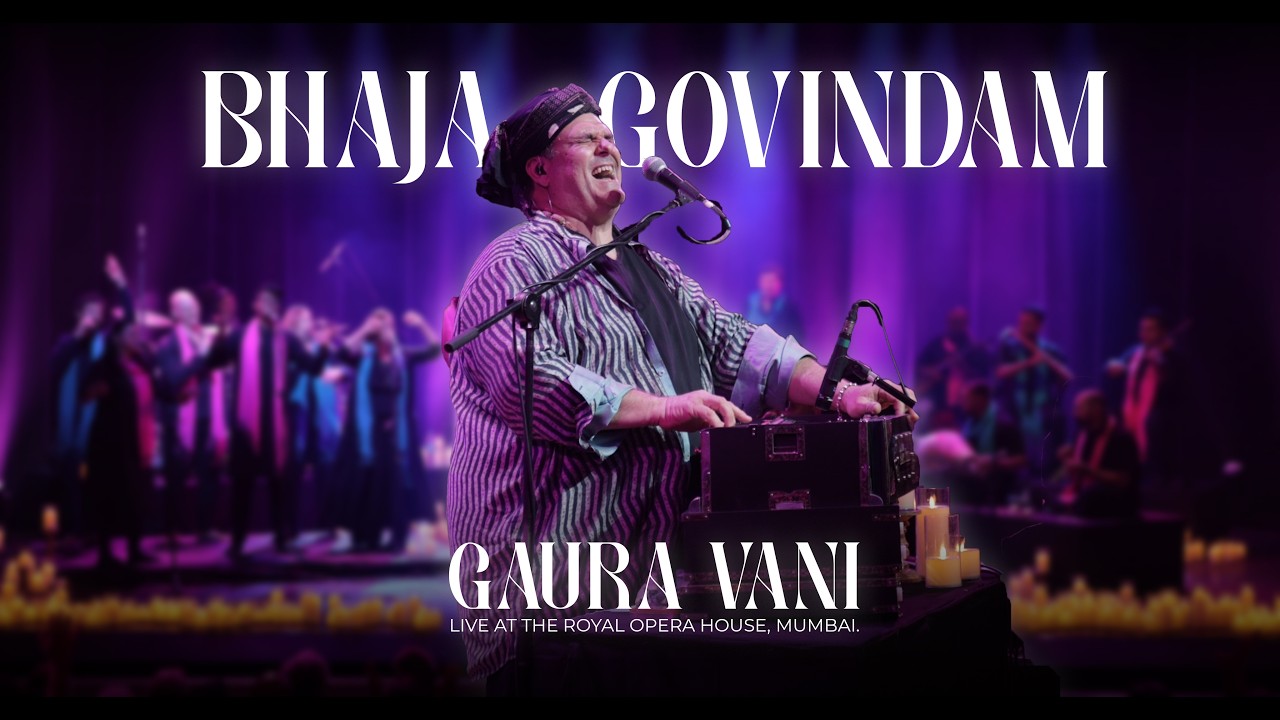
The decision to release Gaura Vani's musical version of the Narasimha Kavacha on Narasimha Chaturdashi carries intentional weight. Narasimha Chaturdashi is celebrated annually as the appearance day of Narasimha—the date, according to the calendar of devotion, when this protective form emerged from the pillar to save Prahlad. On this sacred day, millions of devotees around the world remember that moment of divine intervention, that rupture of stone releasing protection into the world.
This particular 2023 release coincides with the 41st anniversary of the sannyasa initiation—the monastic dedication—of HH Radhanath Swami, a significant teacher in the Gaudiya Vaishnava tradition. In lineages where Prahlad's devotion is celebrated as exemplary, where the protective form of Narasimha is invoked as refuge, this alignment of dates and teacher milestones becomes meaningful. The mantra, released on Narasimha's appearance day, honors both the ancient protection offered to Prahlad and the contemporary work of teachers continuing that lineage into the present.
The timing also reflects something deeper about how these traditions understand the nature of protection. The mantra is not being offered as historical curiosity or cultural artifact. It is being offered as a living tool, renewed on the date that has always been sacred to its invocation. Gaura Vani's rendering—with harmonium drone underneath, with the sacred syllables chanted over that continuous sonic bed—makes the mantra accessible to modern listeners while maintaining its traditional power and integrity.
The Practice: When and How to Use This Armor
For someone encountering the Narasimha Kavacha for the first time, the entry point is simply listening. Unlike some practices that require formal initiation or months of preparatory study, this mantra meets you where you are. Gaura Vani's recording allows a listener to receive the chant without needing to know Sanskrit, without needing to understand the full theological context, without needing to memorize anything. Listen. Let the harmonium drone and the chanted syllables work on you. Presence is the only requirement.
The tradition suggests specific contexts for this practice, though it is not limited to them. When difficulty arrives—loss, fear, uncertainty—the Narasimha Kavacha is offered as recourse. In times when you feel undefended, when circumstances seem overwhelming, when you need to remember that there is a force (divine, archetypal, or simply your own will aligning with an ancient current of protection) that can meet what confronts you, the mantra is there. Play it. Sit with it. Allow it to remind you of Prahlad's story: that devotion itself can be armor.
Some devotees recite the mantra daily, not only in crisis. For them, it is preventive medicine—a daily renewal of alignment, a regular practice of putting on spiritual armor before the day begins. Others reach for it specifically in difficulty, keeping the recording on their phone for moments when they need it. Both approaches are honored in the tradition. There is no hierarchy of practice. The mantra works whether your faith is absolute or tentative. The tradition itself suggests that even listening, even passive reception of the chant, is said to offer purification and protection.
Where to Go From Here
The story of Prahlad—a small child who refused to abandon his faith even when tormented by his father—speaks to something timeless in human experience. It speaks to the knowledge that there are forces larger than our circumstances, and that devotion itself can be a form of power. Narasimha's emergence from the pillar, the rupture of stone to release protection, reminds us that help often arrives in forms we do not expect, at the precise moment when it is needed most.
The Narasimha Kavacha brings that story into your own body. Word by word, breath by breath, verse by verse, it maps your physical form to the protective presence described in the mythology. For those seeking protection—spiritual, emotional, psychological, or simply the courage to endure what comes—the mantra offers something its tradition has promised for thousands of years: armor forged from sound, from intention, from the collaboration between the ancient and the present moment. In reciting or listening to the Narasimha Kavacha, you are not starting a new practice in isolation. You are joining a lineage of devotees reaching back to Prahlad himself, all of them invoking the same protective presence, all of them discovering that their own bodies can become the vehicle of that protection.