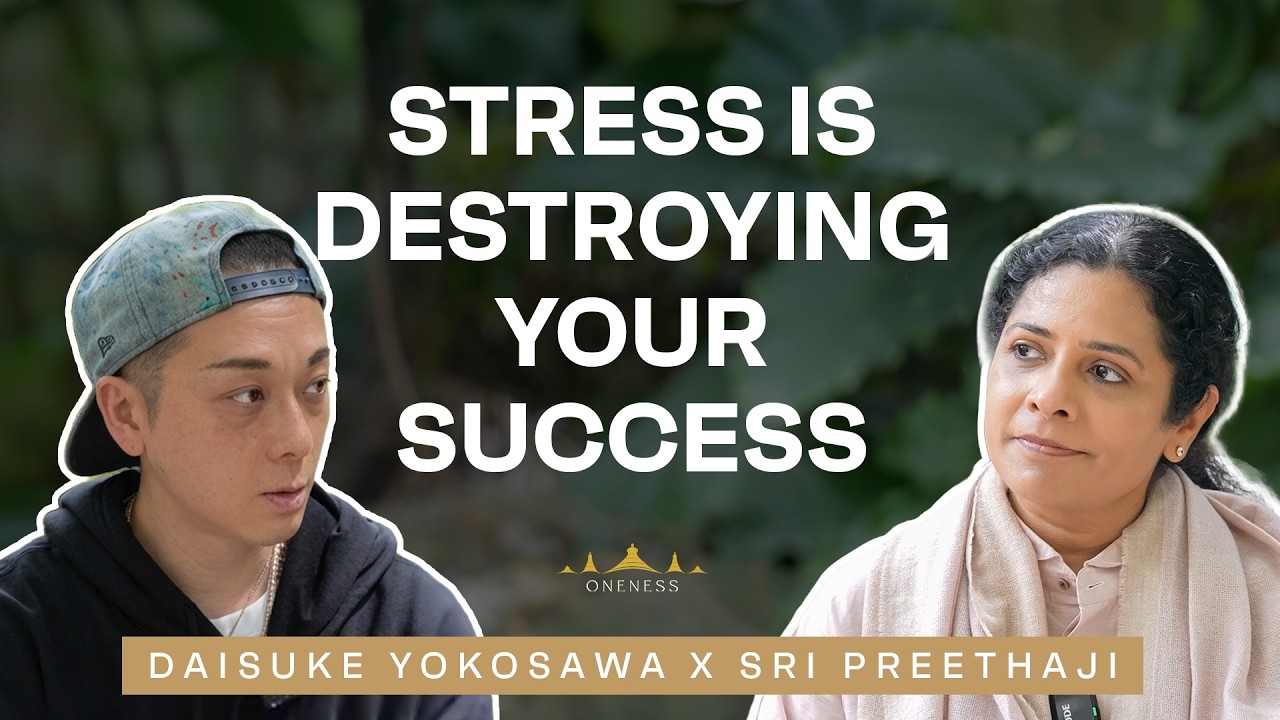
Sri Preethaji and Sri Krishnaji examine the root causes of escalating global conflicts through the lens of consciousness and disconnection. Rather than attributing wars solely to political, economic, or ideological factors, they argue that the underlying cause is humanity's separation from oneness consciousness—a fundamental state of recognition that all beings are interconnected. When individuals and societies operate from a consciousness of separation rather than unity, competition, fear, and violence become inevitable. This teaching suggests that true peace requires a collective shift in human consciousness toward recognizing our shared essence and interdependence.
According to the Oneness Movement teachings presented by Sri Preethaji and Sri Krishnaji, wars and conflicts are not primarily caused by resource scarcity, political disagreement, or historical grievances alone. Instead, the fundamental cause lies in humanity's disconnection from what they call "oneness consciousness"—a state of awareness in which individuals recognize their essential unity with all beings and nature.
When consciousness is fragmented and operates from a place of separation, people naturally perceive others as "other," as fundamentally different from themselves. This creates a psychological and spiritual distance that makes it easier to harm, dominate, or wage war against those perceived as foreign, threatening, or inferior. The conflict, in this view, is not a political problem to be solved through negotiation alone, but a consciousness problem that must be addressed at the level of human awareness itself.
The teaching distinguishes between two fundamental modes of human consciousness: unity consciousness and separation consciousness. When operating from separation consciousness, the mind creates rigid boundaries between self and other, us and them, my nation and your nation. This creates what might be called a "scarcity mindset"—the belief that resources, power, and security are limited, and that one group must gain at the expense of another.
From this state of consciousness, several destructive patterns emerge:
- Fear and threat perception: When we perceive others as separate and fundamentally different, we naturally experience them as potential threats. This activates survival instincts that justify preemptive aggression and accumulation of power.
- Competition instead of cooperation: Separation consciousness reframes human interaction as inherently competitive. Nations compete for resources, influence, and dominance rather than seeking mutually beneficial solutions.
- Dehumanization: When others are seen as separate from ourselves, it becomes easier to dehumanize them, to view their suffering as irrelevant to our own wellbeing, and to justify their destruction.
- Ideological rigidity: From separation consciousness, ideologies become tools for justifying why "our way" is right and "their way" is wrong, leading to militant enforcement of belief systems.
The teaching addresses why wars and conflicts appear to be escalating in the modern world despite technological advancement and increased global communication. This paradox can be understood through the lens of consciousness: even as global connectivity increases, the underlying consciousness of separation may be intensifying rather than diminishing. Globalization, competition for resources in an overstretched ecosystem, and rapid social change may actually be deepening feelings of disconnection and threat.
Additionally, modern societies have largely abandoned collective practices and worldviews that cultivated oneness consciousness—such as spiritual or contemplative traditions that emphasized interconnectedness and shared humanity. Without these counterbalances, the default mode of separation consciousness becomes dominant, manifesting as increased polarization, nationalism, and conflict.
Oneness consciousness, as taught by Sri Preethaji and Sri Krishnaji, is not merely a philosophical idea but a direct experience of interconnectedness that can be cultivated and awakened. In this state of consciousness, the boundaries between self and other become permeable. A person operating from oneness consciousness experiences the wellbeing of others as inseparable from their own wellbeing. Harming another becomes as illogical as cutting off one's own arm.
From oneness consciousness emerges:
- Natural compassion: When we genuinely recognize another's experience as similar to our own, compassion arises naturally without effort.
- Cooperation: Problems are approached as shared challenges requiring collaborative solutions rather than zero-sum competition.
- Shared security: In oneness consciousness, true security comes from the wellbeing of all, not from dominance or control over others.
- Flexibility and understanding: Different perspectives and approaches are recognized as valuable ways of solving shared problems, rather than as threats to truth.
A core teaching of Sri Preethaji and Sri Krishnaji is that individual consciousness and global events are not separate. The consciousness of individuals aggregates to create the consciousness of families, communities, nations, and the world. This means that an increase in oneness consciousness among individuals directly contributes to a decrease in global conflict. Conversely, the expansion of separation consciousness multiplies conflict at every scale.
This is not to suggest that individual meditation alone will end all wars—structural, political, and economic factors matter. However, the teaching emphasizes that lasting peace cannot be achieved through external measures alone. True peace requires that humans awaken to their fundamental interconnectedness, and this awakening must happen at the individual level before it can manifest at the collective level.
While the video does not detail specific practices, the Oneness Movement is associated with various methods designed to awaken direct experience of interconnectedness. These typically include meditation, contemplative practices, and processes designed to dissolve the sense of separation and activate the experience of unity. The underlying principle is that oneness consciousness is not something to be created but rather to be uncovered—it is the natural state of awakened human consciousness once the veils of conditioning and identification with the ego are removed.
If the teaching of Sri Preethaji and Sri Krishnaji resonates with you, consider exploring the fundamental question: To what extent does your own consciousness operate from separation or unity? Begin by noticing moments when you naturally experience connection with others—when their joy feels like your joy, or their pain touches your heart. These moments of oneness consciousness are available to everyone and represent glimpses of a way of being that is fundamentally at peace. Deepening and stabilizing this experience through contemplative practice may be one of the most significant contributions an individual can make toward reducing global conflict. Explore the teachings of the Oneness Movement directly for specific practices and further guidance on awakening oneness consciousness.