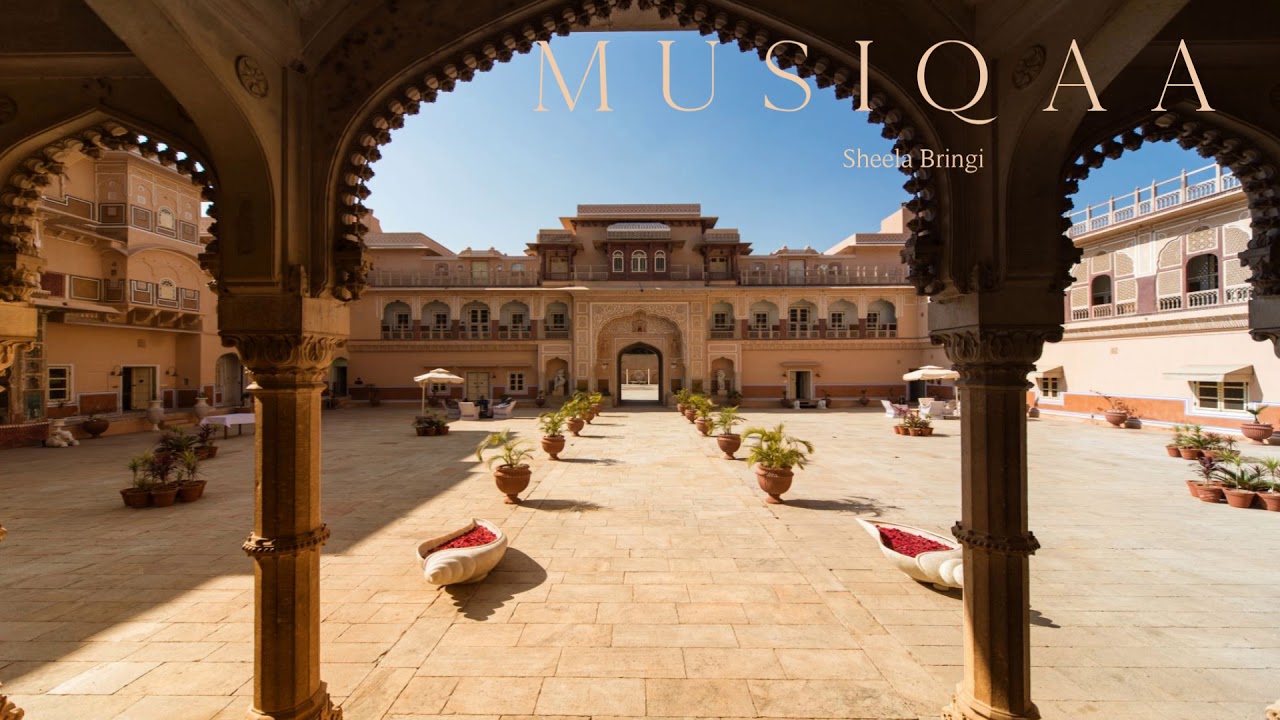
In a studio in Sofia, Bulgaria, Sheela Bringi draws her fingers across the strings of a harp—not the concert grand of Western classical tradition, but an instrument tuned and voiced to honor the microtonalities and resonant patience of Indian classical music. What emerges is a mantra, an invocation addressed to Saraswati, the Hindu goddess of wisdom, learning, and the arts. The prayer has existed for centuries; this rendering is entirely of the present moment. It is the work of a musician who has chosen to make the harp itself a vessel for raga.
The mantra, drawn from Sanskrit sources, opens with Om Aiim Hreem Shreem Saraswati Devyai Namaha—an invocation that names the goddess and bows to her. The subsequent verses ask for yogic powers, for mastery in learning and in craft itself. "O Goddess Saraswati, fulfiller of all my wishes. Grant me your yogic powers. I begin my learning, may I achieve perfection in it always." In the phrasing lies a recognition that learning is not mere accumulation; it is discipline, it is prayer. It is work conducted in the presence of something larger than oneself.
Who is Saraswati, and why does she matter now?
Saraswati sits at the root of Hindu cosmology as the embodiment of knowledge, creative expression, and music itself. Iconographically, she is inseparable from the veena, the South Indian stringed instrument, and from sound as a pathway to truth. In classical Indian philosophy, Saraswati represents vak—the divine voice, the word-principle through which reality itself is articulated. To sing to her, to play music in her honor, is to acknowledge that creativity is not a secular pleasure but a spiritual practice.
The goddess is traditionally depicted in white—the color of purity and clarity—seated on a lotus, her four arms holding a veena, sacred texts, prayer beads, and a water vessel. Each attribute speaks: music, knowledge, devotion, and the flow of grace. In an age of fragmentation and noise, the invocation of Saraswati carries a particular weight. It is an asking for focus, for the clarity that comes when learning becomes meditation.
The harp as an unlikely gateway into raga
The choice of instrument here is worth attention. The harp—particularly as adapted to serve raga—is a recent arrival in the vocabulary of Indian classical music. Unlike the veena, the sitar, or the sarangi, it does not emerge from centuries of refinement within the classical tradition. Yet Bringi's approach suggests that the harp, with its capacity for sustained resonance and its ability to voice multiple frequencies simultaneously, can serve the deeper aims of raga: the exploration of a single note-world, the meditation on relationships between pitches, the embodiment of a particular emotional or spiritual state.
Raga itself is not a scale in the Western sense; it is a melodic framework, a grammar of relationships, and a spiritual discipline. Each raga carries associations with specific times of day, seasons, and emotional dispositions. To approach a raga on the harp requires understanding that the instrument's limitations become its strengths—the player must work with what the harp can and cannot do, much as a classical musician works within the constraints of their chosen instrument to achieve the deepest possible expression.
Ensemble as spiritual practice
Bringi does not perform this invocation alone. Alongside her are Steve Gorn on bansuri (bamboo flute), Debasish Chaudhuri on tabla (drums), Deepak Ramapriyan on voice and violin, Masood Ali Khan on voice, and Brent Kuecker on voice. This is ensemble work in the deepest sense: not a backing band, but a community of musicians holding a shared intention.
The tabla, with its complex rhythmic vocabulary, has served South Indian and North Indian classical music for centuries. It is the heartbeat of the tradition. The bansuri—particularly associated with Krishna in Hindu mythology—carries its own spiritual weight. Together with the voices, these instruments create a harmonic field around the harp's devotional melody. What emerges is not a performance for an audience but a collective offering.
The production took place at Nuboyana Studios, and the result was mixed with care by Clinton Patterson. The sound design respects both the intimacy of the mantra and the richness of the ensemble. There is no excess; each voice and instrument has its place in a carefully considered whole.
What does it mean to sing a mantra?
A mantra is not a song in the popular sense, though it may be sung. The word itself comes from Sanskrit: man, mind, and tra, to cross over or protect. A mantra is a tool for traversing mental states, for moving beyond the ordinary mind into states of deeper awareness. When a mantra is performed with intention—when musicians gather to voice an ancient prayer—something shifts in the listening field.
The repetition of the Sanskrit phrases is not arbitrary; it is the sound itself that does the work. The specific frequencies of Sanskrit vowels and consonants are understood in classical Indian philosophy to have transformative effects on body and consciousness. To hear them voiced by multiple musicians, held by the resonance of the harp, is to be invited into a particular quality of attention.
This eight-minute piece, released as part of Bringi's album Incantations
To experience this work fully, listen without distraction. Note the way the harp's sustained tones create a harmonic field, the way the tabla's intricate patterns speak in dialogue with the voices. Observe what arises in your own body as the mantra unfolds. If you are drawn to explore further, seek out other recordings of Saraswati invocations in the classical tradition; listen for the variations in how different musicians approach the same goddess, the same prayer. The raga harp tradition is young, but it speaks to something real: the possibility of building bridges between musical worlds while honoring the depth of each. Sheela Bringi's Incantations is available through Udaya Entertainment, an organization dedicated to preserving and presenting classical Indian music in contemporary contexts. Her own work continues to explore the harp as a vehicle for devotional and classical music—an ongoing experiment in what is possible when respect for tradition meets willingness to ask new questions.Where to go from here